
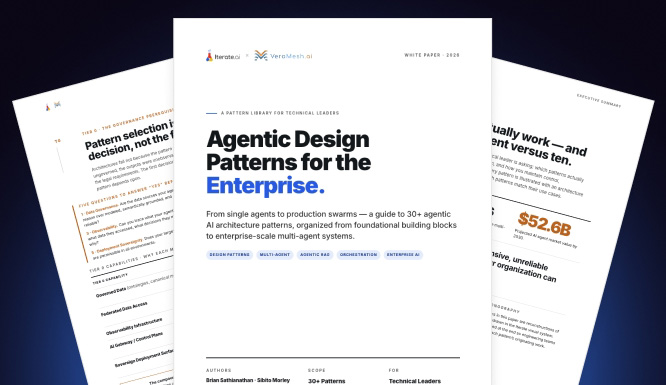
New research from Iterate.ai surveying enterprise AI leaders reveals where autonomous agents break at scale and how leading organizations are responding. Early agent prototypes often show promise. At enterprise scale, however, many leaders find that single-agent approaches alone begin to fall short. The research shows that while foundation models remain essential, organizations are increasingly adopting multi-pattern architectures to scale agents with confidence. What the research reveals:
Download the full whitepaper. Fill out the form to download, and discover the 30+ agentic design patterns enterprise AI leaders are using to move from pilots to production.
The difference between a demo and a production agent is not the model—it is the orchestration pattern. The right pattern turns an expensive, unreliable prototype into a system that your organization can trust, observe, and scale. Anthropic Building Effective AI Agents, 2025