
Why Iterate for AI Outcomes

Get AI outcomes built around your industry, systems, and constraints.

Sometimes the buyer problem is not "Which platform?" It is "How do we get this business outcome into production?" Iterate combines enterprise AI platforms, private deployment patterns, productized applications, and solution delivery to build AI around real industry workflows.
Header image

"We need business outcomes, not only a platform."

Enterprise AI has to meet the business where it is.

Many organizations know what they want AI to improve, but the path from idea to production is blocked by systems, data, workflow complexity, privacy requirements, and internal bandwidth.

Platform gap

A platform alone does not define the workflow, integrations, metrics, and deployment path.

Industry constraints

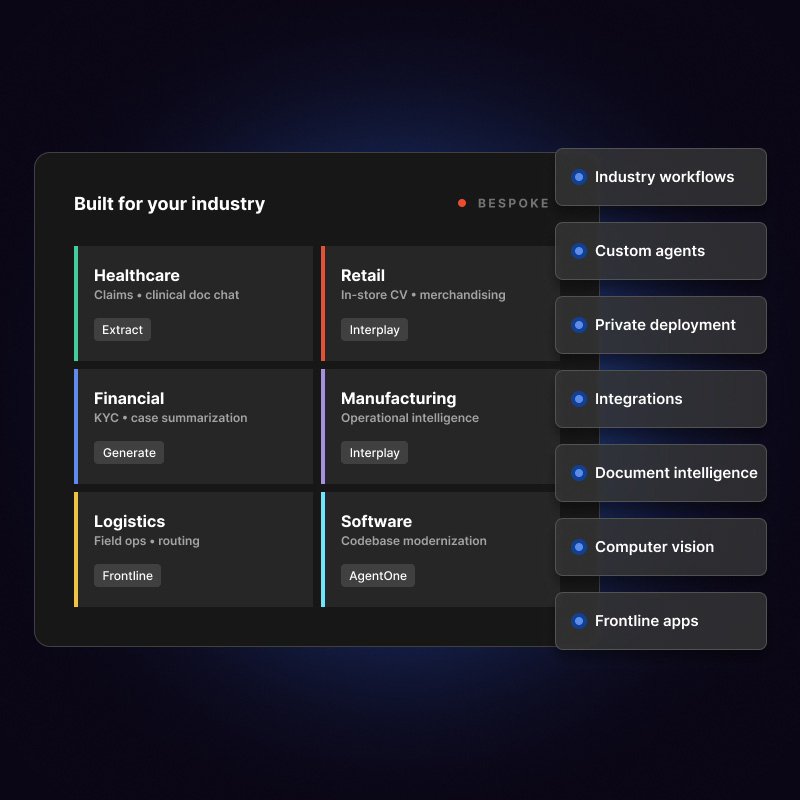
Healthcare, finance, retail, logistics, manufacturing, and field operations each bring different rules and operating realities.

Integration complexity

AI must connect to legacy systems, documents, APIs, data stores, and human workflows.

Execution bandwidth

Internal teams may not have enough AI architecture, product, UX, or engineering capacity.

Production risk

Proofs of concept fail when they lack security, governance, performance, and support models.
Why Iterate

Platform strength plus solution delivery.

Iterate packages its platforms, applications, and AI development expertise into bespoke solutions that are designed for business outcomes from the start.

Start with the outcome

Define the business workflow, user needs, operating constraints, and success metrics before choosing the model.

Use proven building blocks

Combine Interplay, Generate, Extract, Frontline, AgentWatch, and AgentOne where they fit.

Integrate with reality

Connect to enterprise systems, data, documents, processes, and approval paths.

Move to production

Build with governance, observability, deployment, and support requirements in the architecture.
Capabilities

Bespoke solution capabilities

Design and deploy custom AI solutions for industry workflows, integrations, governance, and flexible enterprise environments.

Use case discovery and feasibility assessment
Industry workflow mapping
Custom AI workflow and agent design
Data, document, system, and API integration
Private RAG and document intelligence
Computer vision and operational intelligence patterns
Frontline task and performance workflows
AI-assisted development and software modernization
Governance, observability, and cost controls
Cloud, on-prem, edge, VPC, and hybrid deployment planning
Business Value

Control that supports adoption.

Enterprise AI governance should reduce risk without forcing teams back into experimentation silos.

Translate platform capability into business results.

Shorten the path from idea to production.

Package repeatable solutions for industry pain points.

Support complex enterprise integration needs.

Reduce proof-of-concept waste.

Build around privacy, governance, and deployment realities.

Industry AI Solution Workshop

Turn a priority workflow into an AI solution plan.

Iterate facilitates a focused workshop to define a high-value industry or bespoke AI opportunity, map workflow requirements, identify data and integration needs, and create a practical path to pilot or production.
Business outcome and success metric definition
Workflow, user, and system map
Product and platform fit recommendation
Data, security, and deployment requirement review
Pilot scope, timeline, and investment range
FAQ

Common buyer questions

Is this consulting or product?
It is a packaged path that combines Iterate platforms, applications, and solution delivery around a specific business outcome.
Can this support highly regulated industries?
Yes. The solution architecture can account for data privacy, auditability, private deployment, approval workflows, and compliance requirements.
What if we are still choosing use cases?
The workshop can help prioritize use cases by value, feasibility, data availability, risk, and production complexity.
Who is the buyer for this page?
Business executives, innovation leaders, CIOs, CTOs, operations leaders, product teams, and industry teams with specific AI outcome goals.