
Why Iterate for AI Economics

Make enterprise AI faster, cheaper, and deployable on your terms.

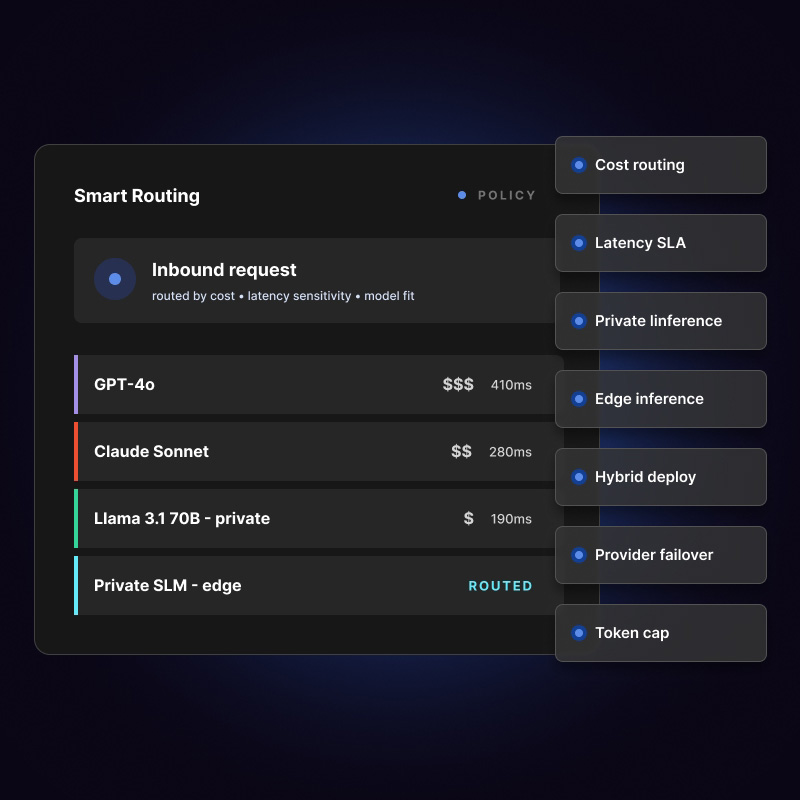
AI costs and latency can rise quickly as prototypes become daily workflows. Iterate helps enterprises optimize runtime performance, route work across the right models, reduce unnecessary token spend, and run AI in private or edge environments where economics and control matter.
Header image

"

AI is becoming expensive or too slow as usage scales. We need better economics, concurrency, latency, and deployment flexibility.

Lorem ipsum dolor sit amet, consectetur adipiscing elit. Suspendisse varius enim in eros elementum tristique. Duis cursus, mi quis viverra ornare, eros dolor interdum nulla, ut commodo diam libero vitae erat. Aenean faucibus nibh et justo cursus id rutrum lorem imperdiet. Nunc ut sem vitae risus tristique posuere.

Shadow AI risk

Employees and teams can adopt AI tools before security, legal, or IT teams have visibility.

API key sprawl

Teams manage keys and provider access inconsistently, which increases operational and security risk.

Limited visibility

Leaders cannot easily see who used which model, for what purpose, under what policy.

Uncontrolled spend

Token usage, budgets, routing choices, and internal chargeback become hard to manage at scale.

Compliance pressure

Sensitive data, audit evidence, and policy enforcement need to be consistent across public and private models.
Why Iterate

One control plane for enterprise AI traffic.

Iterate helps enterprises centralize AI access through AgentWatch, Interplay, Generate, and AgentOne integrations so AI usage can be observed, secured, routed, and measured.

Govern access

Put AI traffic behind a common policy layer with role-based access, API key management, and consistent controls.

Protect data

Screen prompts, detect sensitive data, enforce guardrails, and reduce the chance of data leaving approved boundaries.

Route intelligently

Use provider routing, failover, and private model options to balance reliability, cost, and security.

Prove control

Capture audit trails, usage telemetry, token counts, and policy decisions for compliance and internal reporting.
Capabilities

Governance capabilities built for operational AI.

Centralize the controls enterprise teams need to adopt AI across users, agents, applications, models, and environments.

LLM gateway and centralized AI traffic control
DLP for sensitive data, secrets, and regulated information
API key management and encrypted secrets handling
Audit trails, correlated logs, and request history
Agent observability across business and coding agents
Prompt screening and guardrail enforcement
Multi-provider routing, custom routing, and failover
Role-based access and organization-level control
Token usage tracking, budget controls, and chargeback support
Public, private, and custom model governance
Product Fit

Relevant Iterate products

Combine Iterate products into a governance architecture that gives teams AI access while preserving visibility, control, and accountability.

AgentWatch

Centralized governance, observability, policy enforcement, DLP, provider routing, and spend tracking for LLM traffic.

Interplay

Secure platform and runtime for building, deploying, and orchestrating governed AI workflows and agents.

Generate

Private AI assistant and agent platform for governed enterprise knowledge and workflows.

AgentOne

Visibility and control for AI-assisted development activity across enterprise engineering teams.

Business Value

Control that supports adoption.

Enterprise AI governance should reduce risk without forcing teams back into experimentation silos.

Reduce shadow AI risk.

Improve auditability and investigation readiness.

Control AI spend across teams, apps, and providers.

Govern public, private, and custom model usage from one policy plane.

Apply policy consistently across business users, developers, and agents.

Support compliance-sensitive AI adoption without blocking innovation.

AI Governance Readiness Assessment

Find the gaps in your AI control layer.

Iterate helps your team map current AI usage, identify governance gaps, prioritize control requirements, and define the gateway architecture needed to move from scattered adoption to governed AI operations.
Current-state AI usage and risk map
Governance, audit, DLP, and spend-control gap analysis
Recommended LLM gateway architecture
Provider routing and private model strategy
30/60/90-day governance rollout plan
FAQ

Common buyer questions

Does this replace our existing AI tools?
No. The goal is to govern and observe usage across tools, models, agents, and applications through a central control layer.
Can policies block sensitive data?
Policies can be configured to detect, warn, block, or log sensitive data patterns based on the enterprise control model.
Can this work with multiple LLM providers?
Yes. The architecture supports routing across public, private, custom, and aggregator endpoints depending on policy and business needs.
Who is this for?
CIO, CISO, CTO, AI governance lead, platform engineering, compliance, and finance teams managing AI adoption at scale.