


Interplay is a low-code agentic workflow platform that lets enterprise teams build, orchestrate, and scale AI applications up to 17 times faster than traditional development. It combines a visual node builder with a code-first SDK, running hardware-agnostically across Intel, AMD, NVIDIA, and Qualcomm infrastructure while cutting inference costs by 75-95%.

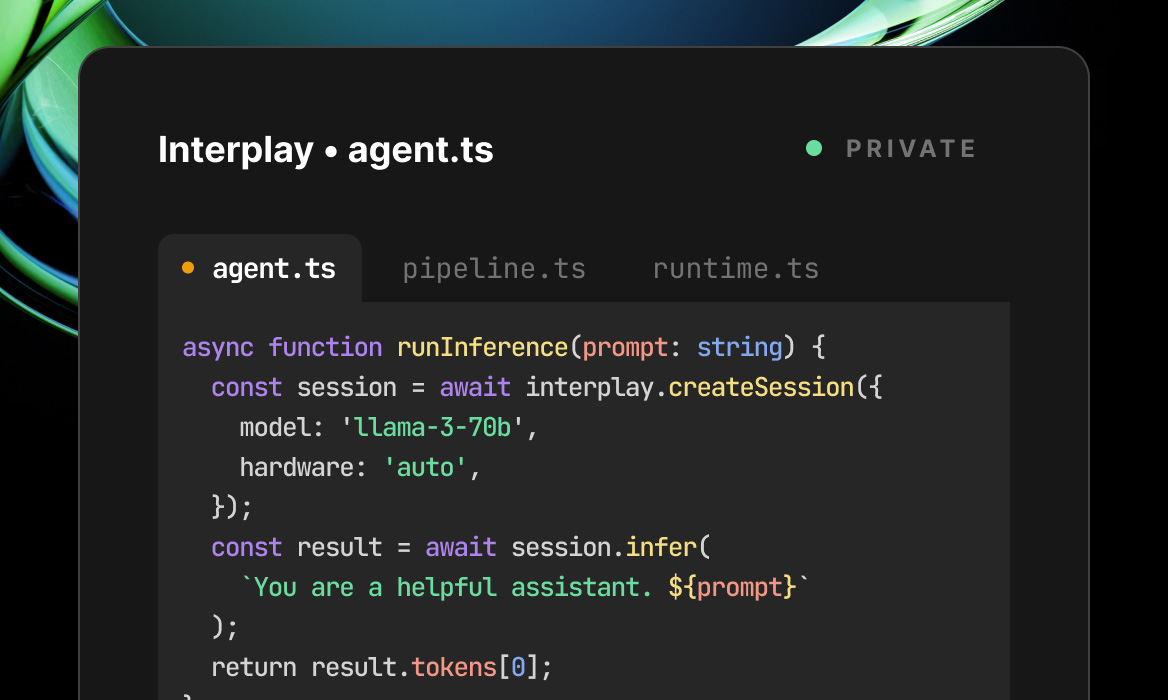
Choose visual, code, or a hybrid approach—all with the same enterprise controls and team features.

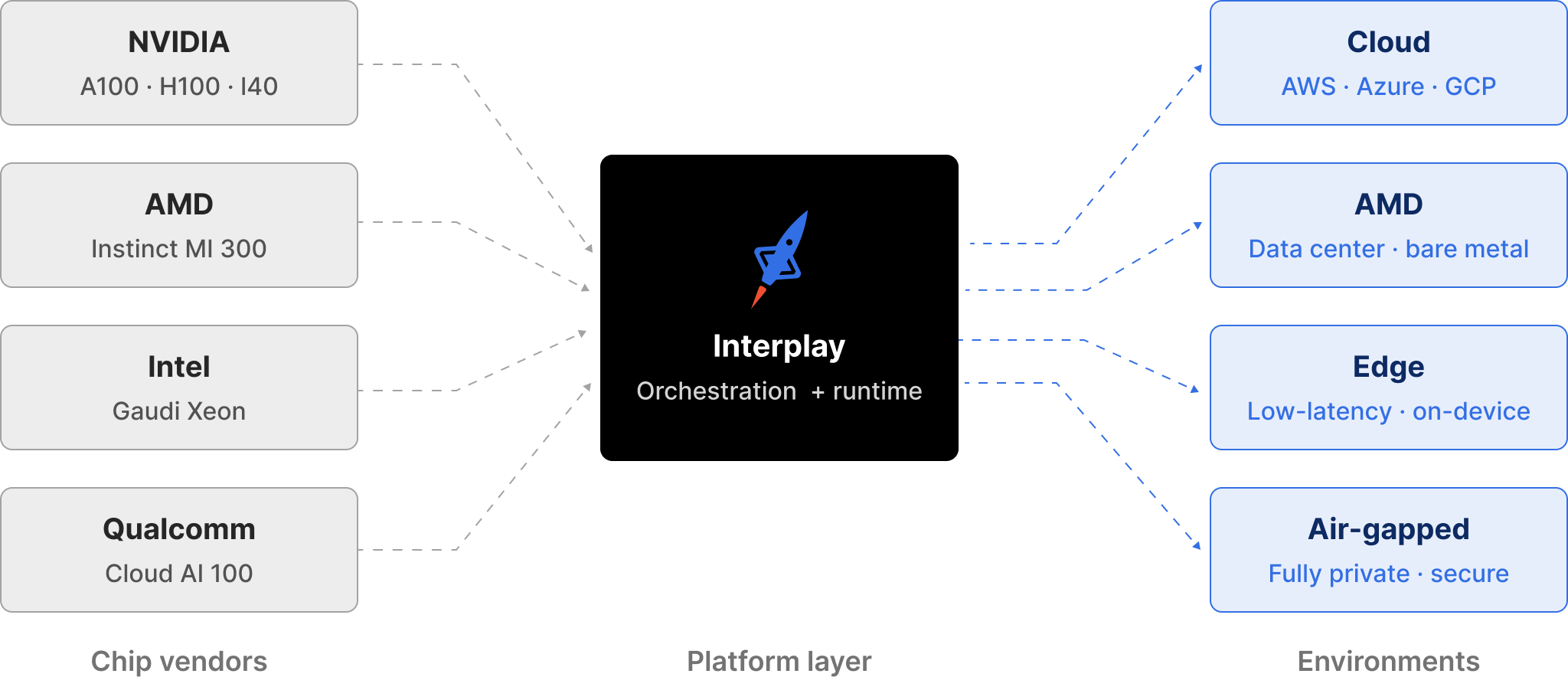
Data centers and chipmakers shouldn't need to rebuild the same plumbing—tokenization, inference, orchestration—for every deployment. Interplay handles it.
Hardware compatibility matrix: Intel, AMD, NVIDIA, Qualcomm, Cloud, Edge, On-prem, Air-gapped
Interplay Runtime optimizes memory, batching, and parallelization to deliver real-time performance while cutting compute and energy usage.
Cost reduction
Faster inference
Energy savings
Interplay adds the enterprise features teams have been asking for—from SSO and audit logging to seamless local-to-cloud development.
Interplay is an enterprise AI platform that combines visual development tools, hardware-agnostic orchestration, and an optimized inference runtime to help teams build and deploy agentic AI applications up to 17 times faster. According to CIO.com, enterprises can prototype AI applications in 2-3 days instead of weeks or months. The platform offers both a visual no-code builder and a code-first SDK, allowing teams to choose their preferred workflow while maintaining enterprise controls
No. Interplay features a visual node builder that lets you create agentic AI flows without writing code—designed for business users and executives who want to prototype ideas quickly. For developers who prefer coding, Interplay also offers a complete code-first SDK with the same capabilities. Teams can use visual tools and code together in a hybrid approach, making AI development accessible to both technical and non-technical users.
Interplay Runtime reduces inference costs by 75-95% while delivering 2-3x faster performance and 95% energy savings. The platform achieves these reductions through optimized memory management, intelligent batching, and parallelization that deliver real-time performance while cutting compute and energy usage. This means enterprises can run the same AI workloads for a fraction of the cost without requiring additional GPU investments.
Interplay is hardware-agnostic and runs on Intel, AMD, NVIDIA, and Qualcomm hardware across cloud, edge, on-premises, and air-gapped environments. According to Intel's partner showcase, Interplay is "adaptable across various environments including on-premises, cloud, and edge." This means you can deploy the same code anywhere without rebuilding for different chipsets—eliminating vendor lock-in and maximizing infrastructure flexibility.
Interplay's hardware-agnostic architecture deploys anywhere with the same code, eliminating lock-in at both the hardware and cloud provider levels. Unlike vendor-specific tools that tie you to particular chipsets or platforms, Interplay's silicon-flexible runtime works across Intel, AMD, NVIDIA, and Qualcomm hardware. Move workloads between on-premises, cloud, and edge environments without rebuilding applications—giving you complete control over AI infrastructure decisions.
Interplay includes enterprise-ready security built in from day one: Single Sign-On (SSO), Role-Based Access Control (RBAC), comprehensive audit logging, and flow-aware version control designed for AI workflows. These features enable collaboration at scale while maintaining security discipline and compliance requirements. Unlike solutions requiring third-party add-ons, Interplay delivers authentication, authorization, and auditability as core platform capabilities.
Yes. Interplay includes a built-in ecosystem with expanded integrations and templates for connecting to enterprise systems. The platform supports seamless local-to-cloud development, allowing teams to develop locally and deploy to cloud environments without code changes. Ready-made applications include custom Retrieval Augmented Generation (RAG) frameworks, LLM Drive-Thru, and Computer Vision solutions leveraging Intel OpenVINO toolkit and Intel PyTorch extensions.
Interplay serves five primary groups: (1) Enterprise AI Teams building production applications, (2) Platform Engineers orchestrating AI infrastructure, (3) Data Centers maximizing hardware ROI, (4) Chipmakers needing optimized software layers, and (5) Developers shipping AI features faster. According to CIO.com, it's particularly valuable for teams that "have an idea and want to prototype it real quick before going to executives"—enabling rapid validation without lengthy development cycles.
From prototype to production, one platform that grows with you.