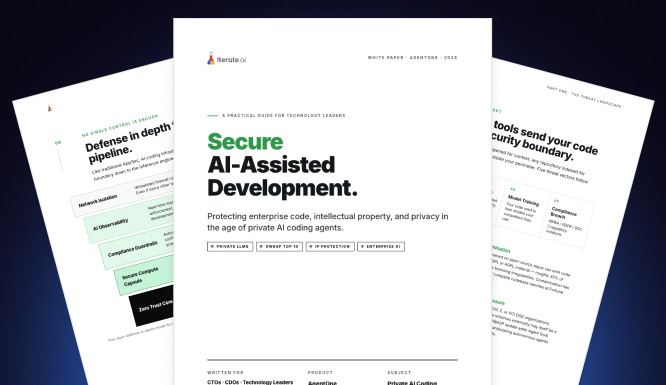
New research from Iterate.ai reveals how 48% of AI-generated code contains security vulnerabilities—and what enterprise leaders are doing about it. AI coding assistants are transforming development velocity. But for regulated enterprises, this acceleration comes with serious risks: code exfiltration, IP contamination, compliance violations, and vulnerability injection at scale. The research shows that while public AI coding tools deliver productivity gains, they create an attack surface most organizations are only beginning to understand. What the research reveals:
Download the full whitepaper. Fill out the form to download, and discover how CTOs and technology leaders are adopting AI coding acceleration without compromising security, privacy, or intellectual property.
67% of enterprises pursuing data sovereignty have already shifted to private AI infrastructure to strengthen regulatory compliance and maintain control over their most sensitive assets. Enterprise AI Security Survey, 2025