
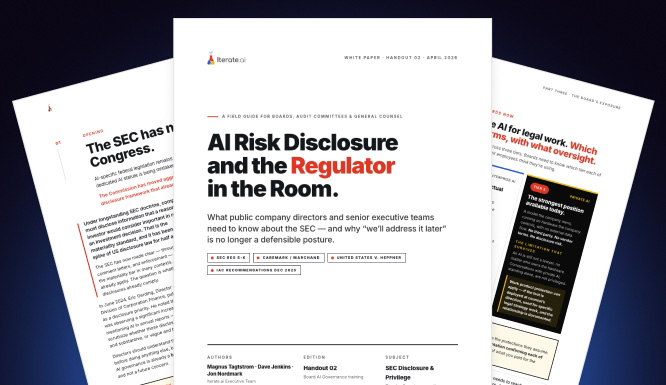
New research from Iterate.ai explains why public company directors and senior executive teams can no longer treat AI governance as a future compliance issue—and what boards must do now to meet rising SEC, litigation, and disclosure expectations.
New research from Iterate.ai explainAI-specific federal legislation remains incomplete, but the SEC has already begun applying existing material risk, cybersecurity governance, and disclosure rules to artificial intelligence. For boards, AI is no longer just an innovation or IT issue. If AI is material to the business, its oversight, risks, vendor dependencies, and public disclosures are already board-level responsibilities.s why public company directors and senior executive teams can no longer treat AI governance as a future compliance issue—and what boards must do now to meet rising SEC, litigation, and disclosure expectations. What the research reveals:
Download the full whitepaper. Fill out the form to download, and learn the six questions every board should be able to answer about AI systems, SEC disclosure accuracy, committee oversight, third-party model dependencies, and legal privilege.
The companies that wait are betting that the SEC, plaintiffs’ attorneys, and institutional investors will not ask hard questions before the rules are fully formed. Based on the trajectory of the past two years, that is not a safe bet.