
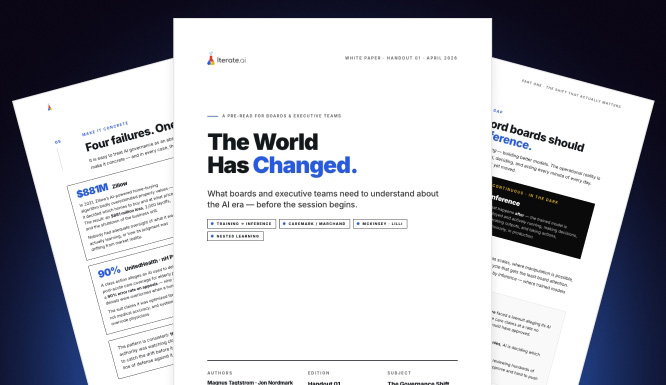
New research from Iterate.ai reveals why corporate directors face personal liability under the Caremark standard if AI oversight structures are inadequate—and what boards must do now. AI has fundamentally shifted from supporting human decisions to making them autonomously at enterprise scale. For corporate boards, this is not a technology issue—it is a governance crisis with direct legal exposure. The research shows that while most boards treat AI as an IT concern, courts and regulators are beginning to hold directors personally accountable for failures in AI oversight under established fiduciary duty standards. What the research reveals:
Download the full whitepaper. Fill out the form to download, and discover the hard questions boards must ask about AI inference, vendor control, shadow AI deployments, and the emerging memory governance challenge before regulatory enforcement and derivative suits arrived. Learning systems now allow AI to learn continuously from enterprise operations, baking institutional knowledge into model behavior that cannot be audited, traced, or deleted. Boards have no governance framework for this.
The governance gap is not just structural—it is a knowledge gap. Oversight without understanding is not really oversight. It is ratification—approving things you cannot fully evaluate. Iterate.ai Board AI Governance Research, April 2026