
Most of a company’s data was never built to be searched. Generate retrieves without moving it, and without a per-token bill that grows every quarter.
A joint educational white paper by NetApp® and Iterate.ai.
Somewhere in every large company sits a warehouse of contracts, claims files, service tickets, and inspection reports that nobody has opened in years. It isn’t lost. It’s filed and stored away on a share drive, in a database, inside a document repository behind the right permissions. Filed is not the same as usable. If no one can ask it a question, it might as well not exist.
That gap between “stored” and “searchable” is called dark data storage: which is estimated at 80–90% of enterprise data.
Public AI tools make a model easy to reach: however, they still can’t access private repositories, and every query creates a token tax that scales and infers regardless of the value delivered. A model is billed by the prompt, and retrieves just general knowledge, not specific actionable intel.
This illustrates two problems: 1) the AI runs somewhere other than where the actual data lives. All those extra steps in copying over data to an external model are time-consuming and expensive; 2) There’s a clear security risk of exposing your proprietary data to a public model and your competitors’ prompts.
Generate is a private AI platform that runs fully inside a company’s owned infrastructure — the models, the retrieval layer, and the vector database all live where the data already lives, instead of the data traveling out to a public model. Nothing about the security perimeter changes, and no data leaves the environment to get an answer. The answer is built on institutional data, returning competitive, actionable intel.
Generate’s connectors can read data wherever it resides, across the entirety of a customer’s data estate. Paired with ONTAP, the data a company has been storing for years becomes the same data its agents can query today — no migration, no separate copy, unveiling data and creating intelligence out of the box.
A fixed-cost, contained platform changes who gets to run a pilot. A team doesn’t need a budget line that grows with every query, and it doesn’t need months of integration work before the first agent sees real data. It needs one connector pointed at the data repository.
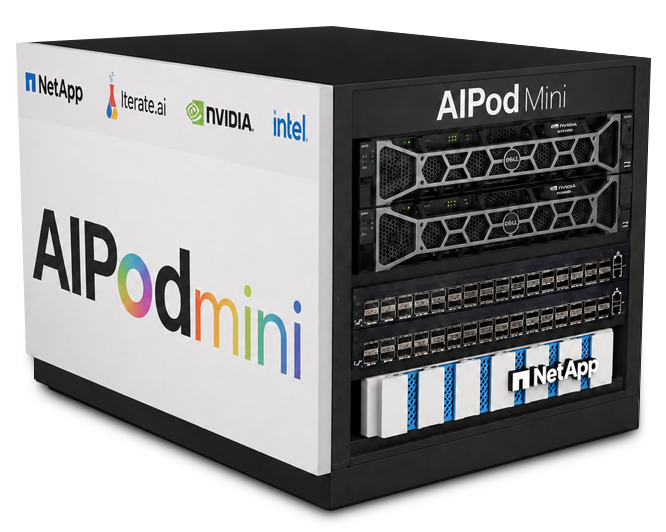
Where this fits in the series. This brief describes the Generate platform as the private-AI layer that sits on NetApp’s infrastructure. It does not restate the AIPod Mini’s hardware specifications or pricing, which are covered in their own briefs.
The End of “Per Token” Costs — how token-based pricing compounds against agentic workloads, and what a fixed-cost alternative looks like.
What’s in Storage — a closer look at what dark, unstructured enterprise data actually contains.
Read the full series at iterate.ai/partners/netapp/private-ai-education-and-certification-program.
A joint educational series on private AI and the AIPod Mini. NetApp — the governed data-control layer. ONTAP stores, secures, and keeps your dark storage private and on-prem. Iterate.ai — the private intelligence layer. Generate turns that data into agents, answers, and decisions in minutes.