
This series of tutorials on private AI claims deployment can be done “under twenty minutes”. Here's how that extraordinary goal is accomplished.
Almost every enterprise data integration begins the same way: make a copy of all the deata, ove the files somewhere the new tool can read them, build a pipeline to keep the copy fresh, then rebuild the permissions that did not come with it. The copy becomes the project. It is where the thirteen weeks go.
Reading the data where it already sits removes that huge time step, and makes overall project deployment take as much time as a coffee break.
These twenty minutes are not a faster version of the old process. It is the old process with the time-wasting copying part taken out.
An appliance that arrives empty is a project. Generate ships with connectors to where enterprise records already live, so minute six is a single configuration screen, not a week-long sprint.
Reads directly from NetApp® ONTAP snapshots. No migration, no second copy. Archived volumes are readable at deployment.
Access controls carry through from the source systems. If a person cannot open a file, the AI acting for them cannot either.
Test agents against production data without touching the live environment, so accuracy is checked on real records.
Ask any vendor where the second copy lives — and what keeps it current.
The diagnostic questions that go with the five criteria above can be found in the document From Empty Infrastructure to Working AI in 20 Minutes. For what sits in those volumes: What’s in Storage. For how governed copy across a split estate: Hybrid Isn’t Indecision.
Full series — iterate.ai/partners/netapp/papers.
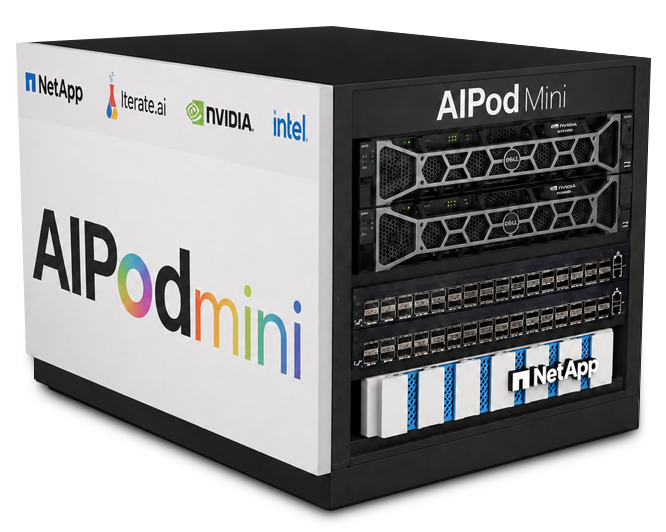
A joint educational series on private AI and the AIPod Mini. NetApp — the governed data-control layer. Iterate.ai — the private intelligence layer.