
Large language model, small language model — two ways to reach the same answer, built at very different scale.
Ask either an LLM or and SLM the same question and you get a similar answer. What differs is everything underneath: how much computing it took to get there, what it cost, and where that computing had to live.
“Explain the main features for our product.” — same question, either side
A shared data center
A server you own
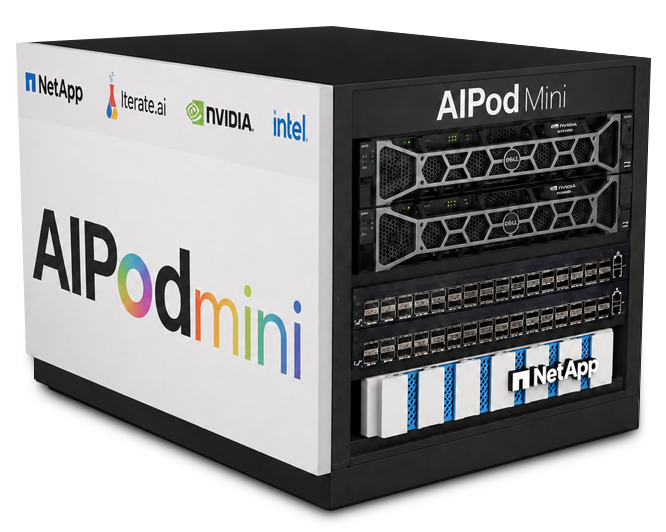
Same output, different scale — scale up for the LLM, scale down for the SLM. About 60–300× lower capital cost on the right.
AIPod Mini is not one giant model pretending to be many things. It is built around several small models, most in the 0.5B–35B range, each suited to a different job.
Right-sizing and privacy are the same move. A model trained for your work is smaller — small enough to run inside your walls, and specific enough that it never has to leave.
Figures from Why Smaller Models Often Win. Roughly 60–300× lower capital cost is the broader, separately sourced industry figure for right-sized models.
Decides which small model fits a job, and fine-tunes new ones for jobs that need their own.
Supports 168 model architectures, so the right one is rarely a stretch to run.
Routes each request to the smallest model likely to handle it. Escalates only on failure.
Full paper, 12 pages — iterate.ai/partners/netapp/papers. On the five ways a model gets smaller, see Why Smaller Models Often Win; on how the routing decision works, What Is a Harness?.
A joint educational series on private AI and the AIPod Mini. NetApp® — the governed data-control layer. Iterate.ai — the private intelligence layer.