
Most “AI suppliers” put a nice screen on someone else's model. Patents show which ones built and invented unique, durable AI applications of their own.
Most AI vendors are a just a thin interface screen on top of somebody else's model. Shared models. Shared hardware. Nothing of their own. When the provider raises its price, the product changes with it — and the customer has no say. There's also no say in governance.
Iterate.ai spent years on the hard parts instead. Speed. Security. Governance. Running models on your own machines. That investment involved over $11M in R&D since 2023. Most of the filing started around 2021, when nobody was asking for private AI yet. Rising token bills and worries about IP leakage have now made that spend extra important.
Not business-method filings. The titles alone show the level they work at.
Counting patents doesn't matter as much as forming families of IP — several patents that protect one invention from different angles. One patent is a lock with one key, and a good engineer can pick it. A family of IP is a vault with many locks. Each one needs a different key.
Iterate has three patent families that back each other up.
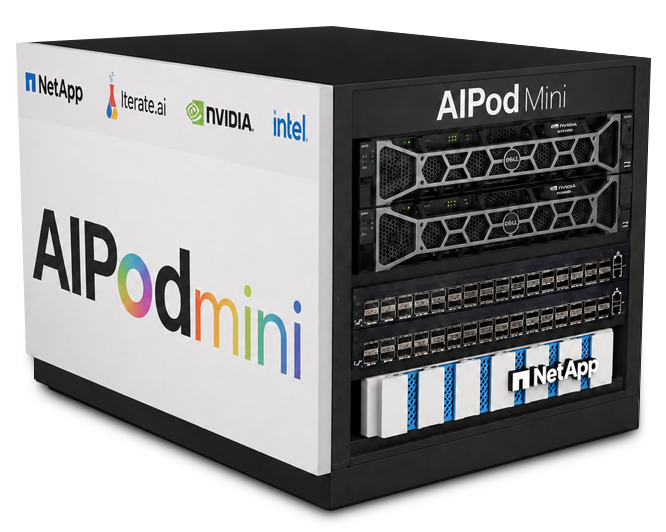
NetApp holds the trusted ground: governed data at huge scale, under controls customers already audit. Iterate holds the patented layer that turns that data into working AI without moving it. Neither replaces the other. Together they offer something a screen on an API cannot.
Many Iterate employees are named on patents. Brian Sathianathan, who leads Iterate's technology team, inspires this activity. He's been granted 17 patents. He learned the discipline inside Apple's secretive New Product Introduction group. He is named on several patents for the original iPhone.
Choosing an AI partner is a ten-year decision. These patents show the work was invented, not assembled. And they show NetApp's partner saw this coming before the market did.
A joint educational series on private AI and the AIPod Mini. NetApp — the governed data-control layer. Iterate.ai — the private intelligence layer.