
Archives have evolved from unreachable, to searchable, to answerable.
Before the common internet era, companies like Iron Mountain* collected physical documents and stored them in highly secure facilities — sometimes underground, sometimes inside hardened vaults. Those files were difficult to reach but legally required: healthcare companies must retain records for years, government agencies far longer.
The storage requirement changed its format rather than disappearing. NetApp, founded in 1992 as Network Appliance, Inc., is the digital evolution of the requirement: fast, durable, governed storage holding records an organization is obliged to keep.
Vaults, caves, microfilm. Records kept safe but slow and hard to reach.
NetApp digitizes enterprise storage, now holding a significant share of the world's unstructured data.
Iterate activates that data — agents that reason, answer, and act on it.
The underlying problem actually survived the transition from paper to disk: it's easy to continue to just add to the archive, but digging information back out from the archive remained a challenge, even with digital formats. Neither earlier stage made the data easier to use. The third transition solves this: AI that runs where the data already sits, so an archive can answer a question instead of just handing back a file.
Organizations with the deepest archives stand to gain the most. Health networks, county agencies, a manufacturer with decades of quality records — each continue to pay to retain material that could never be read at scale.
Reaching the archive is the near-term prize. The larger one is what it can teach. Those records are the accumulated judgement of the organization, and exactly what an AI learns from.
That learning should compound in one place internally. A company's records should never train a shared public model: don't help a model that your rivals use, nor one that could become a rival itself. Train a model you own, and the advantage stays where the data was created.
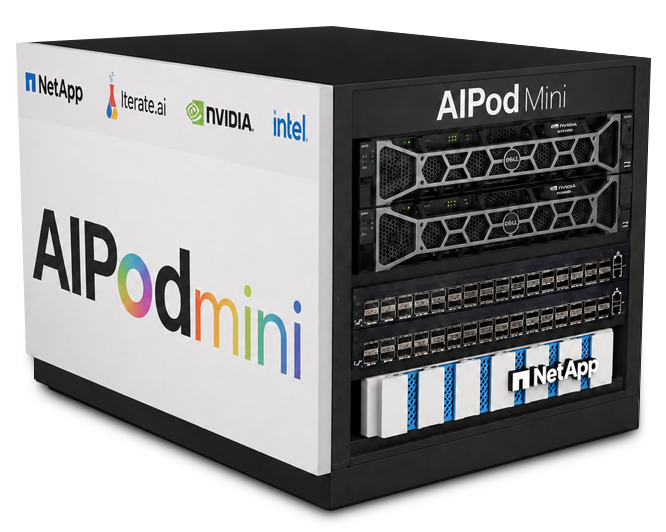
This transition doesn't require moving the archive. AIPod Mini brings the reasoning layer to storage that is already owned: running on ONTAP, in under 20 minutes, with nothing sent to the cloud.
The value was always sitting there, unread. Nobody has to move their data — this brings answers, insights, and learnings from data already there, and to keep what it teaches secure.
A joint educational series on private AI and the AIPod Mini. NetApp — the governed data-control layer. Iterate.ai — the private intelligence layer.