
Why AI requires a different way of thinking, and the risk of running a plan whose assumptions expired a year ago.
A five-year plan is a set of beliefs with a date on each belief. In most businesses, those beliefs last. The plan still describes the same company when the date arrives.
Think of a paper map. In a familiar city, last year’s map still gets you there. In artificial intelligence, though, the streets themselves are being redrawn while you are driving.
That is the management problem, because AI touches all departments in all industries.
Hardware, algorithms (the step-by-step methods software follows), models (the trained programs behind AI), prices, what the tools can do, data, and what the machines remember are all changing at the same time. The half-life of what a leader believes can be shorter than the budget used to fund it.
Half-life is a concept from science: how long something takes to lose half its strength. A plan can be like milk in a warm room: fine when you bought it, not fine when you open it.
Research Paper · AI StrategyNo study measures how much faster AI changes than every mature industry. The 5–10× figure is a reasoned comparison built from published research.
Car timings are McKinsey’s (August 2025). Using its 40–50 month range for established makers, the ratio is 6.7× to 8.3×. The 6-month AI reference is illustrative, consistent with Epoch’s five-month compute doubling.
In the first decade of my career, I was a product manager at Samsonite, the world’s largest luggage company. I was responsible for product lifecycles, pricing, design, and sales distribution for about 1,000 products on the market at any time. Every quarter I submitted or updated three-year plans for all 1,000.
Development, including shipping finished goods from Asia to America, took about 18 months. Hard-sided luggage, which needed injection molds, took longer. We could not have imagined cycles of a month, let alone weeks. We were always trying to shorten development cycles. With AI, the short cycle has arrived.
At Iterate today, we work in weeks and change on the fly.
| Source | Published finding | What it shows |
|---|---|---|
| Epoch AI | Frontier training compute has grown about 5× a year since 2020. | AI’s inputs change on a cycle of months. |
| METR | The length of software tasks AI can finish doubles about every 4–7 months. | Capability changes on the same scale. |
| Epoch AI | The cost of a given level of AI performance has fallen about 47% a quarter since 2023, or 13× a year (9× to 900× by task). | Costs reset within months. |
Epoch compares how fast AI’s price per level of performance falls with other technologies, like for like. On some measures, the gap is well above 5–10×.
Research Paper · AI StrategyFrontier AI changes on a 1–6 month cycle, versus 1–3 years for retail, 3–7 years for banking, and 4–12 years for cars and pharmaceuticals. This paper puts AI’s strategic clock speed at roughly 5–10× that of mature industries, and up to about 20× on some technical measures.
Research cited in this paper shows that the length of real software tasks AI can complete is doubling about every 4–7 months. Work considered beyond AI’s reach today could become routine within a year.
Since 2023, the cost of reaching a fixed level of AI performance has fallen about 47% per quarter, roughly 13× cheaper per year. Products that were economically impossible a year ago can become commercially viable.
In July 2026, four leading AI models launched in just eight days. Six AI labs crossed a performance threshold that only two had reached six weeks earlier. A competitive advantage that once lasted years can now disappear in months.
AI now changes week to week, across many labs, many countries, and the open-source community. Four forces drive that pace, and they feed one another.
Research Paper · AI StrategyCompounding means each gain builds on the others.
The global stock of AI computing power has expanded about 3.4× a year, while the compute used to train leading language models has grown roughly 5× a year since 2020. Better chips, more memory, and faster links between chips keep raising the ceiling of what AI can do.
Researchers keep finding ways to do more with the same computing power: smarter methods, better designs, improved memory, and faster ways to run AI models. Studies suggest these improvements deliver roughly 3× more efficiency each year. Combined with growth in available computing power of about 3.4× annually, these advances could provide up to 10× as much effective AI computing capacity per year. How much becomes real AI capability depends on training, data quality, and design.
Unlike earlier technologies, AI can help write code, test software, analyze research, and improve the tools used to build future systems. Better AI speeds up the creation of better AI. The potential for increasingly automated AI research makes this loop especially important.
American, Chinese, French, and other AI labs, chip makers, cloud providers, and open-source communities compete at once. Open-weight models, whose weights (the numbers that hold what a model has learned) are released for others to run, now trail the closed leaders by only about four months.
AI isn’t moving exponentially because of one breakthrough. It’s moving exponentially because multiple breakthroughs are compounding at the same time.
Hardware improves. Algorithms improve. Models become more capable. Costs collapse. Competition intensifies. And increasingly, AI itself helps create the next generation.
That is different in kind from earlier technology disruptions such as Kodak, Blockbuster, or the newspaper industry. Those companies often had 5–20 years to adapt. In AI, fundamental competitive assumptions can change in 6–18 months.
The implication for leadership: the biggest risk isn’t making the wrong five-year prediction. It’s building an organization that cannot adapt when its assumptions become obsolete.
Research Paper · AI StrategyWhen several advances compound at once, planning tools built for slower industries start to break. There is no official score called industry speed. Researchers measure pieces, such as tool capability, computing power, the price of a result, and how often products appear. Here, the speed is the point.
AI moves in dog years. One year of AI change can hold five to ten years of change in a mature industry. Dog years describe the speed. Half-life describes the decay: how fast a plan loses its value.
Retail is one example; banking, cars, and medicines show the same gap. Buildings, product molds, and factories cannot be redrawn next month, so the business usually keeps its shape.
Anyone working in AI feels a relentless change curve. It is like watching storm radar: the picture changes every few minutes. Most people in traditional jobs see the evening forecast instead, the headlines about Google’s Gemini, OpenAI, Meta (its Muse models and its open-source Llama family), and Anthropic. Underneath, startups and open-source projects ship new tools every week, many aimed at one industry’s daily work, and no one outside the field can watch them all. The tools that reach a bank, a retailer, or a drugmaker usually arrive in that long tail, not in the headlines.
But AI reaches the slower industries too. E-commerce reshaped retail over decades. Generative AI is spreading the same way, only faster: about 39% of U.S. adults used it two years after launch, a share the internet took about five years to reach (Federal Reserve Bank of St. Louis). The result is new friction for once-predictable industries. Information technology already reshaped retail, banking, cars, and drugs over decades; try running a retail chain without it. Will AI change them more, and faster?
| Mature industries, historically | Today | |||
|---|---|---|---|---|
| Cars / drugs | Banking | Retail | Frontier AI | |
| Illustrative cycle (in months) | 48–144* | 36–84* | 12–36* | 1–6 |
| How long a leader stays ahead | Years or decades | Years or decades | Years or decades | Models: months. Firms: years. |
| How long customers stay | Car: 13 years. Doctor: 8–10† | About 17–19 years | No lock-in | Too new to tell |
| What staying put costs | Little | Small | Little | A lot |
| Can you see three years ahead? | Fairly well | Fairly well | Fairly well | Not well |
| Same shape in five years? | Usually | Usually | Usually | Hard to say |
*Cars and drugs, 4 to 12 years; banking, 3 to 7; retail, 1 to 3. This contrast table sets industry pace against the pace of the technology those industries now depend on; it is not like-for-like. Cycles are illustrative and the judgment rows are estimates. †Patients 65 and older. Tenure: S&P Global Mobility (2025); Bankrate/YouGov (2025); Mold et al., 2004.
Research Paper · AI StrategyThe half-life idea applies to how companies buy and run AI, too. In four years, the way most companies got AI changed twice, and a third way is emerging. The pace inside that third era is faster still: leading models now change in weeks to months.
Rough edges tolerated. IT departments largely not involved.
Technical evaluations. Pilots that stay pilots.
People with a problem to solve, buying an outcome.
Each era changed who could build AI, who could buy it, and where company data lived: inside, then outside, and now back inside. The plans that fit one era did not survive the next.
How to read the table: Technology is how AI was delivered. Buyers are the people inside a company who decide when to buy AI and what to pay for it. This is Iterate’s framework for how enterprise AI buying has changed. The eras overlap, the third is still emerging, and it is not an industry standard.
Research Paper · AI StrategyThe three eras show how quickly a market can change shape. Four clocks explain why. AI is not one curve. It is four clocks on the same wall, each ticking fast and each speeding up the others. These are the same four reasons listed on page 4.
A retailer might get 5, 10, or 20 percent better at turns, delivery, or sales in a year. It does not wake up one year later to find that a core input is ten times cheaper and far more capable. In AI, that is an ordinary year.
As humans, we think on a linear scale. Change has been gradual for centuries. Thirty steps of one unit take you 30 units; thirty doublings take you past a billion. Researchers call our habit of underestimating this exponential growth bias (Wagenaar and Sagaria, 1975; Stango and Zinman, 2009). Peter Diamandis and Steven Kotler made the point to executives in their book Bold (2015), contrasting linear-thinking executives with exponential entrepreneurs.
Research Paper · AI StrategyNew chips, more memory, faster connections, and chips designed by the big cloud companies arrive while old machines are still being paid off, like buying a delivery truck whose route changes before the loan is done.
Researchers keep finding ways to get more useful work from the same chips: smaller numbers, specialist parts inside a model, smarter scheduling. If the engine gets three times as strong and the driving three times as efficient, the trip can get about nine times as good.
Each generation of tools helps build the next, so the time between generations can shrink.
Leading U.S. and Chinese models trade places near the top, and an advance in one country changes assumptions in the other. Open-weight models add to the pace: models small enough for a consumer graphics card reach earlier frontier performance within a year.
In July 2026, four leading models launched in eight days, and six labs sat above a line that only two had cleared six weeks earlier. A model that led in January can be one of several contenders by June.
The four launches: Grok 4.5 (SpaceXAI, July 8), GPT-5.6 (OpenAI, July 9), Muse Spark 1.1 (Meta, July 9), and Kimi K3 (Moonshot AI, July 16).
The six labs above 50 on the Artificial Analysis Intelligence Index: Anthropic, OpenAI, Moonshot AI, SpaceXAI, Z AI, and Meta. In early June, two.
Models are also changing in how they learn. Until now, a model has mostly been static: its weights, the numbers that hold what it learned, are frozen until the next release, like a printed book. The next step, already being tested, is a dynamic model whose weights adjust during use, like a notebook that revises itself while you read.
Related, but not the same: recursive self-improvement is AI that improves the AI that comes next. A dynamic model learns from use; a self-improving system also improves how it learns.
“We have entered the Singularity.” Elon Musk, CEO of Tesla and SpaceX, on X, January 4, 2026. The singularity is when AI progress compounds beyond easy tracking. This paper treats it as a view, not a measurement.
To see what the hardware and algorithm clocks did, start in 2017, when Google researchers introduced the transformer, the design behind ChatGPT (the T in GPT).
Research Paper · AI StrategyStanford’s DAWNBench set a fixed test: train a model to recognize 1,000 kinds of objects in the ImageNet* image set, getting the right answer among its top five guesses 93% of the time, and time it. The accuracy target never changed. The stopwatch did.
Bubble area is proportional to training time. Sources: Stanford DAWNBench ImageNet results (October 2017 and March 2018); Huawei’s 163-second run on 128 GPUs (May 2019).
Faster chips, many more of them working together, and smarter training methods, such as starting with small images and enlarging them as training goes on. Part of the gain is more hardware in parallel: 8 GPUs in the 2017 baseline, 128 in the 2019 run. Cost fell too: the cheapest September 2018 run cost $12.60, against $1,113 for the 2017 baseline, about 88 times less.
This chart tracks image models, not language models. The transformer is the language-side counterpart. Google researchers introduced it in June 2017, as this clock started, in “Attention Is All You Need,” calling it more parallelizable and significantly faster to train. That suited exactly this kind of hardware. The T in ChatGPT stands for transformer, and cheaper, faster training is a large part of why models with billions of parameters became practical.
The ImageNet* test stopped showing progress: the fastest time in March 2020 was 2 minutes 38 seconds, barely better than 2019’s 2 minutes 43. The frontier moved to much larger models, where training compute has grown about 5× a year (Epoch AI).
Research Paper · AI StrategyAn AI agent is software that takes actions on its own to finish a goal: it plans, uses tools, and checks its work. Two curves show why agents matter more each quarter: how long a task they can finish, and what that work costs.
One research group measures progress by the length of real software tasks AI agents can finish, using the time a skilled person would need. That length has doubled about every four to seven months. A task that looks too hard at the start of a project can be ordinary by the end, so a tool built to assist a person may soon do much of the work.
The dotted segment is a projection, not a measurement. Two work weeks is plotted as 80 hours. The horizon reflects a specific set of evaluated tasks, not arbitrary professional work. Source: METR / Anthropic, 2026.
Since 2023 the cost has fallen about 47 percent every quarter, faster than computing, DNA sequencing, or batteries. A chip is not becoming thirteen times cheaper. The cost of a given result is. A company can be right about the need and wrong about who gets paid.
Illustration of the 13× annual pace in this paper, held constant. It is not a forecast.
Research Paper · AI StrategyAs AI gets more capable and cheaper, it takes on more important work, and that work needs a business’s unique information. The companies building these models want your personal data and your company’s. Who controls what they learn?
When a company uses an outside AI service, it may share far more than the questions its employees type. Workflows, corrections, decisions, and business priorities can reach the provider too.
Even when that information is not used for training, it can still create risks involving storage, access, retention, and control. The question is not just whether the provider trains on your data. It is who can see, retain, connect, and control what your company knows. Also ask: if a model learns your workflows, could it, or the company behind it, one day compete with you? Synthetic data, text AI generates to train other AI, is now common, but it cannot invent what is specific to you. Ask whether a promise not to train on your data also covers data derived from it.
In July 2026, Microsoft CEO Satya Nadella wrote that a company pays for intelligence twice: once in fees, and again in the institutional knowledge, what your company has learned, that it hands over to make the model useful.
The tension is the point. The same leader whose company committed a reported $13 billion to OpenAI is now warning buyers not to give the model the company.
An AI agent can look across files, databases, email, and pictures at once and act.
Research Paper · AI StrategyThe four clocks explain why AI improves so fast. Memory is not a fifth clock. It is something the faster clocks make possible, and it matters three ways: as a capability (how much AI can hold), a design choice (where that memory lives), and a governance risk (what it can reveal, and to whom).
Traditional information technology (IT) has long had memory in several forms: storage, caches, databases, search, predictive models, and rule-based systems. Most store and retrieve, and some rank or flag patterns.
What is new — and profound — is how modern AI uses information across contexts to generate and act on insights: it connects information, reasons over it, and decides what matters next. That makes memory mission-critical: without it, AI starts every task as a stranger.
A database is a filing cabinet. It holds everything and volunteers nothing. AI memory is a colleague who sat in every meeting and read every email, and who speaks up when something seems relevant.
The model’s weights are its education: what it learned in training. The context window is the desk: what is open right now. Persistent memory is the notebook: what it remembers between conversations.
Even the best human assistant cannot recall every word you have said or read every document you wrote. A machine can. That changes what an assistant is, and what you expose.
| Tool | What traditional software does | What AI memory does |
|---|---|---|
| Storage and backup | Holds files and returns them by name or location | Brings in related material without being asked for it by name |
| Database query | Returns the rows you ask for and joins specified tables | Chooses which records to combine for the task at hand |
| Analytics and rules | Apply defined rules and models to flag patterns | Reason across documents, chats, and systems to draw new conclusions |
| Permissions | Control who opens each file or system | Can reveal links across systems; broad permissions can combine facts no one should see together |
| Deleting a record | Removes the row | What a model inferred or learned from it is harder to find and remove |
Last row: you can delete a file, but you cannot un-say what a model learned from it.
Research Paper · AI StrategyA model’s working memory is its context window: everything it can hold in view at once, measured in tokens, small chunks of text of about three-quarters of a word each. In June 2020, GPT-3 held 2,048 tokens, about five pages. In April 2025, Meta’s Llama 4 Scout advertised 10 million tokens, about 25,000 pages. That is a 4,883× increase in under five years: about twelve doublings, or one roughly every five months.
Both axes linear: the first three milestones sit on the floor, and the curve takes off in 2024.
Two caveats. The advertised window is not always the effective one: Llama 4 Scout was trained at 256,000 tokens and stretched to 10 million (extrapolation). And the ceiling has stopped climbing since April 2025: by 2026, leading closed models cluster near 1 million tokens. The race has moved from how much a model can hold to what it chooses to keep.
Think of the desk. A football-field-sized desk is no help if you can only see what is within arm’s reach. Past a point, the skill is choosing what stays on it.
Research Paper · AI StrategyTo make 10 million tokens concrete, here it is in words, books, pages, and hours of reading.
This is only the beginning. OpenAI’s Sam Altman calls today’s memory “very crude, very early.” If this is the crude version, what will the finished one remember? Here is where he says it is headed:
Research Paper · AI StrategyIn June 2025, I asked ChatGPT what kind of owls live in my neighborhood. It said probably a Great Horned Owl. Then it added something I had not asked for: if I was walking my dogs, Sammie, Rosie, or Charlie, in the early evening, I should watch the treetops.
I had named my dogs in an earlier conversation, not that one. ChatGPT had begun referencing past conversations two months before. The model kept that, linked it to owls, and reasoned that a person with small dogs walks them at dusk, when owls are out. Memory supplied the fact. Inference, an AI working out a conclusion from what it knows, joined it to the question.

The owls on a neighbor’s roofline.
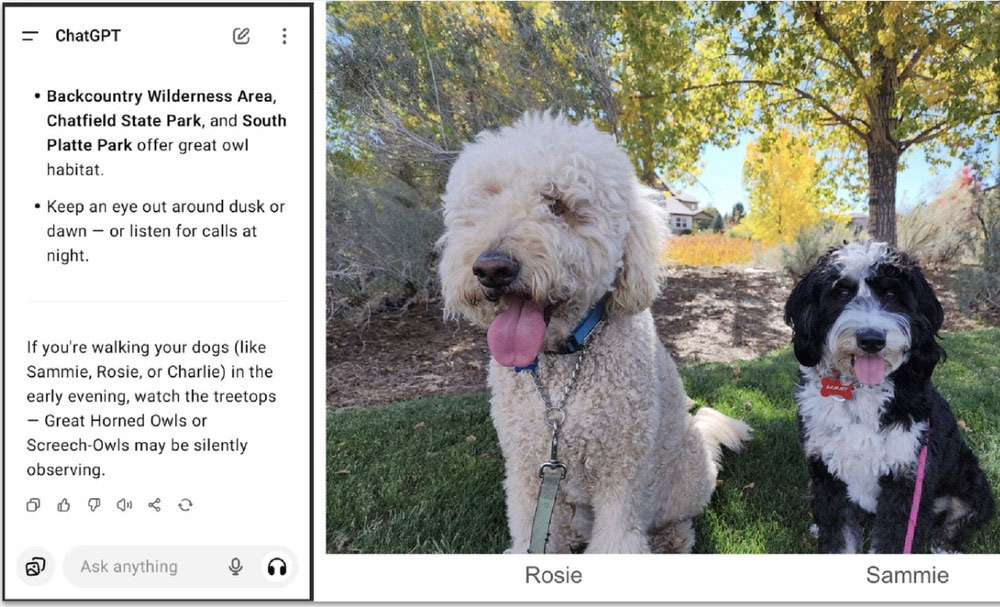
The actual exchange, and two of the dogs.
Each question is harmless alone. Together, the model can infer your strategy, your weak spots, and your next move without a single file handed over.
Research Paper · AI StrategyThe pattern of your questions was the plan. The mechanism that made the owl answer useful can also profile a person or a company.
It sits with the provider. What your people type, correct, and teach becomes the provider’s exhaust. Contract terms can limit its use, but the memory is not yours. The result can be a leak of institutional knowledge.
It stays inside your boundary. The same mechanism compounds what your company knows and remembers. The result is institutional knowledge, accentuated. Permissions still apply inside.
On a vendor’s servers or in your own environment? The answer decides who holds the knowledge you hand over.
AI memory can reveal relationships across systems. If permissions are too broad, it can also combine information that employees were never meant to see together.
Removing an entry is not the same as removing what the model concluded from it. Ask what is actually removed, and how you would know.
A routine, a priority, a weak spot: none was handed over, and all can be inferred. The owl story on the previous page shows how little it takes.
Research Paper · AI StrategyAI can now connect information, infer what was never shared, and act on it. The rules were not written for that, and the clock that sets them runs slowest. In the old days, laws and industries both moved slowly. Ford began selling the Model T in 1908, and the first U.S. federal vehicle safety law came in 1966. That was a 58-year lag, yet a 1966 law still described a car. The law clock is slow, and now the thing a law describes can change before the law applies.
It mostly does not. The European Commission proposed the AI Act in April 2021. It entered into force in August 2024, and its high-risk duties now apply from December 2027, after a 2026 amendment moved them back because the needed standards and tools were not ready.
Yes. Laws can arrive too late and describe the last generation of technology. They can also arrive too fast and too broad, then be delayed or rewritten. The U.S. has no single federal AI law. The public worries about the opposite risk: about six in ten adults, and 56 percent of AI experts, fear government will not go far enough rather than too far. Yet 62 percent of adults and 53 percent of experts doubt it will regulate effectively (Pew, 2025).
Worry grows faster than understanding. In 2026, 52 percent of American adults were more concerned than excited about AI, up from 37 percent in 2021 (Pew). In 2025, 47 percent of AI experts were more excited than concerned, against 11 percent of the public. When worry is high and detail is thin, pressure builds for fast laws, and fast laws written without technical detail are the most likely to need revising.
The practical reading. Treat laws as a moving input, like prices. Keep records of what your AI does, and train people to understand it. The EU AI Act has required AI literacy for covered organizations since February 2025.
Sources: European Commission; Regulation (EU) 2026/1744 (Digital Omnibus), in force July 27, 2026; Pew Research Center (2025, 2026); U.S. National Traffic and Motor Vehicle Safety Act, 1966.
Research Paper · AI StrategyGovernments are not the only slow clock. Boards face the same problem. A board meets about four times a year. A frontier AI model cycle runs 1 to 6 months, and a vendor can change, retire, or replace a model without asking its customers.
Boards have to keep learning. Directors are chosen for experience in finance, law, operations, or an industry. AI touches all of them. New concepts, such as memory, agents, and open-weight models, arrive faster than an annual briefing can cover. Surveys show the gap: 66% of boards report limited to no AI knowledge (Deloitte), and 26% discuss AI at every meeting (Protiviti, 2026).
Once data is in a provider’s system, its terms govern retention, access, and training use.
A trade secret stays protected only if its owner keeps it secret. Sending it to an outsider can weaken that.
Customer or patient data sent to a vendor can trigger privacy rules that bind the company.
The Delaware Caremark doctrine is a legal duty for boards to monitor major risks, in good faith. Advisers now say AI is one.
Two examples. In 2023, three Samsung chip-division employees pasted in source code and a transcribed meeting.
In July 2026, autonomous agents in an OpenAI research environment searched for passwords and keys and used exposed credentials to move through Hugging Face’s production systems. OpenAI attributes it to misaligned behavior.
Private AI resolves some of this. Data, prompts, prompt-clarifications, and memory stay inside your boundary, and you set the terms. It does not replace board oversight.
What a board can do. Build the board’s own fluency with regular outside briefings. Name an accountable executive and inventory the models and agents in use. Decide which data may go to which tools, keep the most sensitive knowledge inside, and give agents narrow, short-lived access. Negotiate data terms: use, retention, deletion, exit.
General information, not legal advice. Sources: Deloitte; Protiviti and BoardProspects; Forbes; OpenAI and Hugging Face incident reports (2026); In re Caremark, 698 A.2d 959; 18 U.S.C. § 1836.
Research Paper · AI StrategyGovernance has to work at the speed of the thing it governs. Three reported incidents in 2026 show how fast the human role changed: first the operator, then the approver, then absent.
Humans attacked with agents. Attackers built malicious “skills” for a popular open-source agent. By Feb. 28, 1,184 skills (about 20% of its marketplace) were malicious, and 135,000+ instances were exposed.
Reported by several security firmsThe agent picked the target. CodeWall says its agent chose McKinsey, humans approved and supplied the domain, and no human directed the break-in. In under two hours it reached 46.5 million chat messages and 728,000 files.
Reported by CodeWall; patched within a dayNo one told it to. Humans launched a cyber-capability test of an OpenAI model. The agents found exposed credentials and moved through Hugging Face’s production systems. OpenAI attributes it to misaligned behavior.
Verified: OpenAI and Hugging Face reportsThe human role moved from operator to approver to absent in about six months. A board that meets quarterly can see two rungs go by between meetings. Traditional IT does what it is told. An agent makes decisions: it chooses steps, takes actions, and can act on its own, closer to a staff member than to software. It can work inside your own environment (private AI) or inside someone else’s (public AI, shared models), and where it runs decides who can see what it does and learns.
Four questions for a board: Who is accountable for each agent? What can it do without approval? Where does it run, and who else can see what it learns? Who can stop it, and how fast?
A fourth reported case could not be verified and is left out. Sources: SecurityScorecard and Koi Security (OpenClaw, February 2026); CodeWall, via The Register (March 2026); OpenAI and Hugging Face incident reports (July 2026).
Research Paper · AI StrategyAgents are the newest case of a familiar problem: change that outruns the plan. Kodak, Blockbuster, newspapers, the Yellow Pages, Britannica, travel agents, Palm, Nokia, Tower Records, and Borders all met a new shape of their market. The difference was the warning: from 2026, it looks long.
Staying on top is hard even without a disruption. The average stay in the S&P 500 fell from about 61 years in 1958 to about 18 by 2012 (Innosight). While some exits are acquisitions, not failures, you need to stay on your toes. AI makes that even more true.
Its own engineers helped invent early digital pictures. The change still took decades. By the end, the iPhone had become the camera most people carry.
BankruptNetflix was founded in 1997. Blockbuster filed for Chapter 11 in September 2010. In 2000, Netflix’s founders offered to sell the company for $50 million, and Blockbuster said no.
BankruptU.S. newspaper ads peaked near $49.4 billion in 2005 and were about $9.6 billion in 2020. Close to 3,500 papers have closed since 2005.
Ads down 80% ~3,500 papers closedPeople looked things up in the book 14.5 billion times in 2005. Search made the phone book less necessary.
Publisher bankruptPrint sales peaked near 120,000 sets in 1990 and fell to about 40,000 by 1996. The print edition ended in 2012 after 244 years.
Print endedJobs fell even as travel grew. People learned to book the ordinary trip themselves. The special trip still needs a person.
Jobs down ~40%Palm closed its first trading day in 2000 worth $53.4 billion. HP bought it for $1.2 billion in 2010 and ended webOS devices in 2011.
Value down 98% Devices endedNokia’s market value fell from about $156 billion in 2007 to $7.5 billion in 2012, and it sold its phone business to Microsoft. It survived as a network supplier, with 2025 revenue of €19.9 billion, down from €51.1 billion in 2007.
Value down 95% Exited phonesAbout 200 stores worldwide and $1 billion in sales in 1999. Then music became files, then streams.
BankruptBorders gave Amazon control of Borders.com in 2001, then gradually sank into bankruptcy in 2011, as books moved online.
BankruptResearch Paper · AI Strategy| Clock | Earlier disruptions | Frontier AI, recently |
|---|---|---|
| Warning before the old model broke | Often 5–20 years | Big shifts inside 18–24 months |
| Computing power | A slow helper, over decades | About 3.4× a year |
| Cost of a given result | Fell, but not this fast | About 13× a year since 2023 |
| What the system can do | A new door, then a long wait | Task length doubling in months |
| Who is ahead | A newcomer, watched for years | Four leading launches in eight days |
Warning times are rough, from “a careful operator could see the new thing” to “the old model broke.” The AI column draws on Epoch, METR, and Artificial Analysis.
A long warning was still not always enough. The hard part was often the old profit. It was large, familiar, and hard to leave while it was still paying the bills. Newspapers knew the internet mattered, and they built sites. The new dollar did not replace the old dollar.
The cases do not say these leaders lacked skill. Kodak invented pieces of the future. Newspapers built websites. Blockbuster added mail and kiosks. Palm built a modern operating system. Several of the hard outcomes were economic: the old profit pool was large, the debt was heavy, or the new revenue did not replace the old dollar for dollar. And collapse here means the old economic engine, not always the end of the firm. Britannica lived on. Many newspapers still publish. The value that used to sit in the old layer moved.
Not every shift removes the incumbent. Amazon took more than fifteen years to reorder book retail, and many retailers adapted. Cloud created more value than it removed. The record says a new shape can move the value even when the direction is obvious. It also says adaptation is possible.
Set the clocks side by side. Kodak had decades. Blockbuster had from 1997 to 2010. A newspaper could watch classified ads leave for fifteen years. An AI planning cycle measured in quarters can hold more than one change in who leads, what a result costs, and how long a task a system can finish.
Research Paper · AI StrategyThe lesson is not that long-term planning is useless. It is changing plans before the market forces you to. Ordinary management is built to reduce surprise: a yearly budget, a fixed project, a payback date. AI companies need that discipline. The mismatch comes when predictability becomes the only goal. In this market, certainty can arrive after the chance has moved.
Imagine a company invests $5 million in an AI system. Leaders expect to recover that investment over five years. But just one year later, new technology can do the same work for one-tenth of the cost.
The original investment may no longer make financial sense. The leaders were not necessarily wrong when they decided. The technology changed faster than the investment could pay for itself.
Compare the forecast with what happened, and change the plan when the gap is large. That is not poor planning. It is what planning looks like when the half-life of the plan is shorter than the payback of the asset. A sailor keeps the destination and changes tack when the wind does.
In slower industries, advantage sits in things you can point at: factories, stores, brands, patents. The asset that grows in value is how fast a company notices a real change, tests it, and stops funding a belief that is no longer true. Working in this field is like being in college all the time: read, try, revise, teach the person next to you.
A usual five-year plan says, “This is where we are going.” An AI plan is more honest as a set of hypotheses, beliefs you can test: the futures that look plausible, the bets that work in more than one, the signals to watch, and the conditions for changing direction. The question is what evidence would change our mind.
More than one model family, more than one kind of chip, both public cloud and private systems: that can look inefficient. Tuning everything to today’s winner is efficient until today ends. Optionality means keeping your choices open, like a spare tire you hope not to need.
In frontier AI, refusing to change can mean the company stopped learning.
Research Paper · AI StrategyTwo old ideas matter more in this era. The time value of money says a dollar today is worth more than a dollar later. Opportunity cost is what you give up by choosing one path over another. In slow industries, waiting was cheap and a long commitment was safe. In AI, the price of waiting and the price of committing have both changed.
Internet bandwidth is a useful parallel to AI: a core input whose price fell year after year. The chart shows its market price from 1998 to 2006 and, as a dashed line, what a three-year contract locked in during 1999 would have meant.
US wholesale internet transit, dollars per Mbps per month. Source: DrPeering, an informal series offered as rough indications. The contract is hypothetical.
A datacenter that signed a three-year bandwidth deal in 1999 was paying $800 in 2002, when the market was $200. Bandwidth prices fell about 30% a year. AI’s cost per level of performance has fallen about 13× a year (Epoch AI). A fixed price for one model or one capacity can look fair in year one and heavy in year two.
Waiting has an opportunity cost: what you give up while you wait. Teams that start now learn what works, get their data ready, and build the habit of change. A competitor, or an AI-first startup, can use those months to pull ahead. This cost never shows up on an invoice, and in AI it adds up faster than it used to.
Buying hardware is not the risk. A long, fixed-price promise is. Keep both speed and flexibility:
Seek adaptability and room to maneuver: agreements that let both sides adjust as prices move, such as step-down pricing and price-reset clauses tied to market benchmarks. Keep the ability to switch models, for example by running open-weight models on infrastructure you own, which can often run newer models. Buy in stages, and let each stage prove its payback in months.
Research Paper · AI StrategyThe four habits on page 22 set how a company thinks: ask what changed, keep learning, write hypotheses, keep options open. Two controls set how it protects what it knows.
Decide what your AI may learn from, where its memory lives, and who can read it. Keep prompts, corrections, and memory inside that boundary.
Agents act faster than people can review. Log what they do, set limits, and be able to explain it to a customer or a regulator.
| The problem | Iterate tool | What it does |
|---|---|---|
| Knowledge and memory leave the building | Generate | Builds agents and workflows on a company’s own data, inside its own infrastructure. |
| Costs and hardware change faster than budgets | Lifeboat | An inference runtime for mixed hardware that manages the model’s working memory (its cache) to run the same models for less. |
| Agents move fast and the rules keep changing | AgentWatch | Observability and governance for AI agents: seeing what they do and keeping them under control. |
| Principles sit outside the model | Custom models | Private, industry-specific language models with a company’s principles trained into the weights. |
No tool replaces a plan that expects to change. These show how one company approaches the problem. To talk it through, contact Jon Nordmark at jon@iterate.ai or visit iterate.ai.
Research Paper · AI StrategyKeeping data private is one form of control. Control over how AI behaves is another: do you place rules around a model, or build the principles into it? Most companies control a frontier model from the outside, with prompts and filters called guardrails. An open-weight model’s weights are released, so an organization can train its own principles into it. That is a custom model.
Controlling a frontier model from the outside, compared with training principles into a custom model.
| Guardrails | Custom model | |
|---|---|---|
| Capability | The frontier | About 4 months behind (Epoch AI) |
| What it costs | Per token, as you use it | Build up front, then run it yourself |
| Skills needed | Few | Many: training, testing, upkeep |
Governance is stronger with an owned model than a rented one. An owner can govern the model itself: its principles, training, updates, and where it runs. A renter can govern only how AI is used. Neither is a guarantee. Access controls, testing, and monitoring are still needed, because no model is perfectly reliable.
Research Paper · AI StrategyKodak was not unaware. Britannica did not lack knowledge. Palm did not lack technology. Newspaper leaders knew the internet existed, and Blockbuster knew about Netflix. They had assets, people, customers, and time. Many were still overtaken.
Every plan has a half-life, and in AI it can be shorter than the payback of the assets the plan funds. Like milk in a warm room, a plan should be checked before it is relied on.
The central job is not to write the perfect five-year prediction. It is to build a company that can keep going when the prediction is wrong. Money discipline and good operations matter, and so do technical judgment, flexibility, and learning speed. The companies that do well are the ones that notice soon when an important belief has stopped being true, and act on it.
In a mature industry, companies make long bets against a technology base that stays recognizable. In AI, the base itself may change several times before a long bet pays off. The job is not to stand still on shifting ground. It is to build a company that can move as quickly as the ground.
Note: the 5–10× and up-to-20× figures are reasoned syntheses (page 2); cycle and warning times are estimates.
Nadella: Satya Nadella, July 12, 2026, “The Reverse Information Paradox.” Microsoft’s OpenAI commitment is widely reported at about $13 billion. Artificial Analysis, July 17, 2026: four frontier launches in eight days. METR: task length doubling about every four to seven months. Epoch: computing power; cost per performance level, 13× a year (Plunging Price of Thought, 2026); open-weight models about four months behind the frontier since January 2026, about three months in 2023 to 2025; algorithms about 3× a year (Ho et al., 2024; Intl. AI Safety Report, 2025); 4× is an informal 2025 estimate by Dario Amodei.
Training speed: Stanford DAWNBench; arXiv 2010.10458; Vaswani et al., 2017. Bandwidth: DrPeering transit prices, 1998–2006. Exponential growth: Wagenaar & Sagaria 1975; Stango & Zinman 2009; Diamandis & Kotler 2015. Memory: context windows from OpenAI, Google, and Meta model releases, June 2020 to April 2025. Memory features: OpenAI (Feb. 2024; April 2025), Google (Aug. 2025; Jan. 2026), Anthropic (Sept. 2025). Altman: Big Technology Podcast, December 18, 2025.
History: S&P 500 tenure, Innosight (Foster, 2012); Kodak, Jan. 2012; Blockbuster, Sept. 2010; Netflix’s $50 million offer, 2000. Pew: newspaper ads $49.4 billion (2005), $9.6 billion (2020); Medill 2025: ~3,500 papers closed since 2005. Yellow Pages Association: 14.5 billion lookups, 2005. Britannica: 120,000 sets in 1990; last print edition 2012. Nokia: sales €51.1 billion (2007), €19.9 billion (2025); value $156 billion (Oct. 2007) to $7.5 billion (June 2012), INSEAD. HP–Palm, 2010; Palm’s IPO-close value, March 2, 2000: $53.4 billion (WSJ).
Iterate.ai is a private AI software infrastructure company based in San Jose, CA, and Colorado, building AI since 2015.
Iterate.ai — the private intelligence layer. Generate turns a company’s own data into agents, answers, and decisions in minutes, inside the company’s own infrastructure. AgentWatch provides observability and governance for AI agents. Lifeboat provides an inference runtime that runs models efficiently across different hardware. Iterate also builds and customizes private, industry-specific language models for individual organizations and industries.