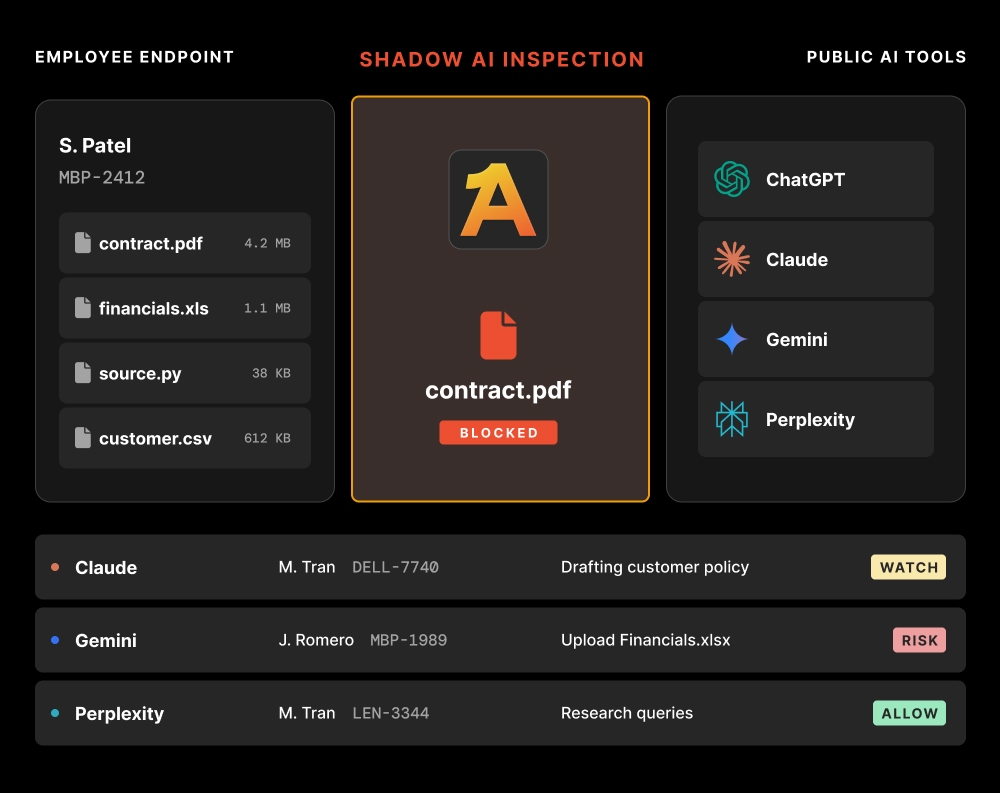
Employees already use public AI tools at work. AgentWatch shows security teams where that is happening and what data is involved, and gives them the controls to act before a leak becomes a breach.
At a glance
- Best for: CISOs, security operations, IT and compliance teams
- Problem: Sensitive data is flowing into public AI tools with no visibility or record
- Outcome: A complete view of public AI usage by user, device and tool, with policy enforced at the endpoint
The challenge
Public AI tools such as ChatGPT, Claude, Gemini and Perplexity are a browser tab away. Employees use them to summarize contracts, debug code and analyze spreadsheets, usually with good intentions and little awareness of the risk. Most security stacks were not built to see this activity.
- No inventory of which AI tools are in use, or by whom
- No way to tell when confidential documents, source code or customer data are uploaded
- No evidence trail when an incident needs to be investigated
- Acceptable-use policies that exist on paper but are not enforced
How AgentWatch solves it
- Discover. AgentWatch detects public AI usage from managed endpoints and builds an inventory of the tools in use across the organization.
- Attribute. Each event is mapped to the user, device, tool and policy status involved.
- Detect. Uploads of sensitive documents, code, contracts or customer data are flagged as they happen.
- Enforce. Policy requirements can be applied before users connect to VPN or other company systems.
- Investigate. Security teams get the evidence they need for investigation, governance and remediation.
Key capabilities
- Endpoint-level discovery of public AI platforms
- Sensitive upload detection for documents, code, contracts and customer data
- Attribution by user, device and tool
- Access requirements tied to VPN and company system login
- Investigation-ready records for security and compliance teams
Example scenario
A procurement analyst uploads a supplier contract to a public chatbot to get a quick summary. AgentWatch identifies the file as a sensitive document, records the user, device and destination tool, and applies the organization's policy. The security team reviews the event, confirms the outcome, and uses the record to guide follow-up training and point the employee to a sanctioned AI tool.
Who benefits
- CISO and security teams: Measure shadow AI exposure and respond with user- and device-level evidence.
- IT operations: Enforce AI usage policy at the endpoint.
- Compliance and risk: Document AI usage for audits and policy reviews.
- Legal: Reduce the risk of confidential material reaching third-party providers.
Frequently asked questions
What is shadow AI?
Shadow AI is the use of public AI tools with company data outside IT oversight. It creates risk because sensitive information can leave the organization with no record of where it went.
Does AgentWatch block public AI tools entirely?
AgentWatch gives security teams visibility into usage and the ability to enforce policy. Each organization decides which tools and data types are allowed, flagged or blocked.
See shadow AI in your environment. Schedule a demo of AgentWatch.