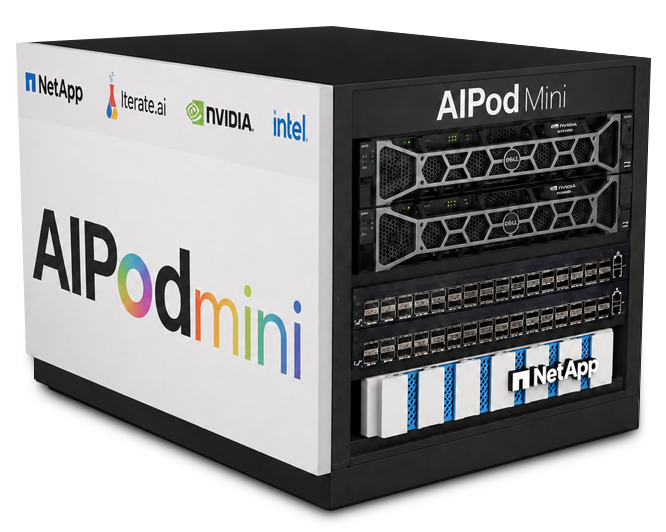

Buyers don't want AI infrastructure. They want a job done. The difference between those two things is whether the agents arrive with the hardware.
When an organization buys an AIPod Mini, it isn't buying AI infrastructure — it's buying outcomes. Those outcomes come from agents, and the agents arrive baked in. Beyond the vectorization and inference acceleration that make the stored data usable, the platform ships with ready-to-run agents that work the moment the hardware is installed.
This matters because the usual enterprise AI pattern is the opposite. Infrastructure lands, a services engagement begins, and months pass before anyone in the business sees a result. That gap is where most AI projects quietly stall.
Agents ship on the platform and run as soon as the AIPod Mini is installed. There is no separate build phase.
An agent can be activated in 30 minutes to a few hours — not the weeks or months a traditional services engagement takes.
No engineering required. A business user can create and refine their own agents directly on the platform.
At one health system, the chief financial officer — not a technologist — built his own agents over a weekend. They analyze paid claims and open accounts receivable, then produce a prioritized plan to recover trapped cash by payer and aging bucket.
Figures are identified opportunity, not collected cash. Even at 12 beds, one agent surfaced a multi-million-dollar finding — produced by the finance lead, not a data team.
As of August 1, 2026, Generate provides 200 Agent Templates out of the box. Some target an industry, some a role, and the sharp ones do both. Iterate.ai and its domain-expert advisors built the set below for hospital finance. A couple, like the AR cash optimizer, would work for a CFO anywhere.
| Agent | What it does |
|---|---|
| Denials | Overview of denials over a determined period of time. |
| Shadow Denials | Claims with no payments that the payer also never classified as denied. |
| Underpayments Summary | Overview of underpaid accounts using historic performance. |
| Research Agent | Deep analysis into a claim's history, including appropriate coding. |
| Appeal Letter Generator | Writes reimbursement letters, including Letters of Medical Necessity. |
| Open AR Cash Optimizer | Guided access to cash-collection opportunities within EDI-merged datasets. |
| Downgraded Codes | Reveals where and when payers downgraded a claim to a lower-paying code. |
| NPI Drilldown | Compare financial performance by NPI. |
| Historic Payment Summary Dashboard | Dashboard of payer performance over time. |
| Revenue Cycle Monthly Report | Covers revenue trends, payer performance, aging, and denials. |
Custom agents can be built by any business user.
A joint educational series on private AI and the AIPod Mini. NetApp — the governed data-control layer. Iterate.ai — the private intelligence layer.