
NetApp
/
Generate Practitioner
/
How the Data Gets In
NetApp
Iterate.ai
NetApp Sellers & Partners
Joint Educational Series
Field Brief · The Twenty Minutes

How the Data Gets In

This series says “under twenty minutes” in eight different places and never once shows the twenty minutes. Here they are.

What you'll learn
  • What happens in each of the four five-minute blocks
  • Why reading data where it sits removes the step that used to take weeks
  • What the system connects to on day one, without anyone writing code
The core argument

Almost every enterprise data integration begins the same way: make a copy. Move the files somewhere the new tool can read them, build a pipeline to keep the copy fresh, then rebuild the permissions that did not come with it. The copy is the project. It is where the thirteen weeks go.

Reading the data where it already sits removes that step, and removing it is what makes the rest fit inside a coffee break.

What a copy costs you
  • Drift. The copy is accurate the day it is made and a little less so every day after.
  • Lost permissions. Access rules rarely survive the move, so somebody rebuilds them by hand.
  • Duplicated storage. You now pay to keep the same records twice.
  • A migration to defend. Every copy is a change a security review has to approve.
MINUTEA WORKING AGENT1–5Unbox and power onTurnkey. No assembly.6–10Point at the sourcesConnectors handle the rest.11–15Permissions carry overExisting RBAC, unchanged.16–20Describe the agentIt builds itself.05101520Nothing is copied, migrated or re-permissioned along the way.
MINUTEA WORKING AGENT1–5Unbox and power onTurnkey. No assembly.6–10Point at the sourcesConnectors handle the rest.11–15Permissions carry overExisting RBAC, unchanged.16–20Describe the agentIt builds itself.Nothing is copied, migrated orre-permissioned along the way.
Not a faster process — a shorter one

Twenty minutes is not a faster version of the old process. It is the old process with the copying taken out.

NetApp | Iterate.ai
How the Data Gets In · 01 / 02

What it plugs into

An appliance that arrives empty is a project. Generate ships with connectors to where enterprise records already live, so minute six is a configuration screen, not a sprint.

CONNECTS OUT OF THE BOXSharePointGoogle DriveDropboxMicrosoft 365SQL / PostgreSQL / OraclePDFs & scanned documentsEnterprise apps & APIsNetApp ONTAP — native snapshot ingestion, no copy made
Three mechanisms worth knowing by name

Snapshot ingestion

Reads directly from NetApp® ONTAP snapshots. No migration, no second copy — and archived volumes are readable too.

Inherited permissions

Access controls carry through from the source systems. If a person cannot open a file, the AI acting for them cannot either.

FlexClone testing

Try an agent against production data without touching the live environment, so accuracy is checked on real records.

Five things “ready” actually means
  • Discoverable. The system finds it without anyone drawing a map first.
  • Readable now. Available at the moment of the question, not after a pipeline.
  • One identity model. One set of permissions, honored everywhere.
  • Good enough. Usable, not pristine. Perfection was never the bar.
  • Reusable. Consumable across the estate without another copy.
Scanned records count too. Ingestion runs OCR over faxes, scans and photographed forms — which is why a filing cabinet from 2011 can answer a question asked today.
One question that exposes every architecture

Ask any vendor where the second copy lives — and what keeps it current.

Further reading

The diagnostic questions that go with the five criteria above are in From Empty Infrastructure to Working AI in 20 Minutes. On what sits in those volumes: What’s in Storage. On one governed copy across a split estate: Hybrid Isn’t Indecision.

Full series — iterate.ai/partners/netapp/papers.

About this series

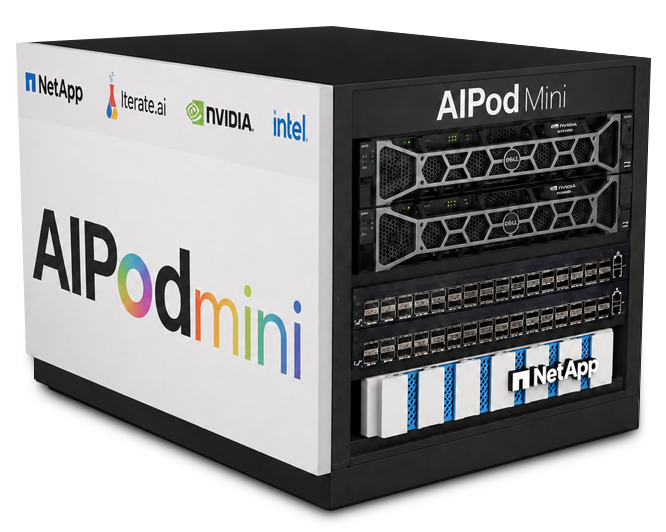
A joint educational series on private AI and the AIPod Mini. NetApp — the governed data-control layer. Iterate.ai — the private intelligence layer.
AIPod Mini
NetApp
Iterate.ai
v1.1 · Aug 11, 2026
NetApp | Iterate.ai
How the Data Gets In · 02 / 02