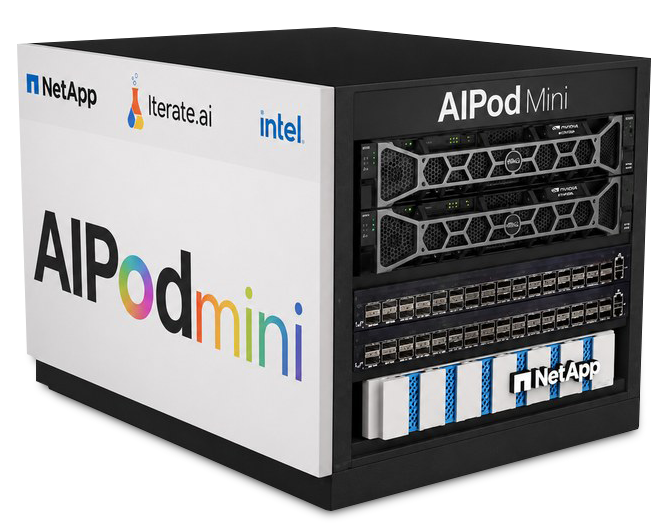

How does a community hospital with $200M in revenue, on the brink of bankruptcy, manage 110,000 denied insurance claims a year — worth >$17M, all disputable? Why does a $7B system need a 25-person team, plus dozens of overseas contractors, to try to keep up with its insurance contracts? Agentic AI, running on AIPod Mini’s GPU/CPUs, gives each hospital three agents as digital headcount — greatly changing the math for both.
In January 2025, KFF (the health policy research group formerly known as the Kaiser Family Foundation) counted the appeals. Insurers on HealthCare.gov denied 19% of in-network claims in 2023. Fewer than 1% of those denials were ever challenged. Not because the denials were correct. Checking one denial means reading the very complex payer contract behind it. Almost nobody has the time or energy.
Picture what one hospital’s contracts hold. A 2024 study of ten hospitals (24 to 815 beds) found each juggling about 52 payer contracts — one ran past 63,000 negotiated rate lines under six reimbursement formulas that change with every amendment. Across a large system’s hospitals, that totals in the hundreds. People can’t hold it. Agents can. Here’s how it works:
Answers, then forgets. Waits to be asked again, one prompt at a time.
Reads, decides, drafts. Hands a person finished work to edit or approve. The AIPod Mini ships with agents prepacked — useful immediately, out of the box.
Most AI business cases begin with estimated labor savings, which are hard to prove. Revenue recovery is different. A payment received is a number on a bank statement. That said, one $7B hospital system estimated its employees would become 12× more effective and productive.
Assessing offices run about 2,500 parcels/employee, per the IAAO — ~37 staff for a 100,000-parcel county, most doing appraisals, not hearings. Even a conservative 1% dispute rate (national rates run 2–5%) means 1,000 appeals a year. Staff pull the record, run the comps, and defend each case at a hearing. Los Angeles County’s board is now 12–24 months behind. Imagine how AIPod Mini could help.
Iterate.ai built three agents for insurance claims in Brazil. They are a Vehicle Risk Assessor, a Statement Consistency Analyzer, and a Claim Irregularity Detector. Together, they translate Portuguese-language reports, cross-check photos and interviews, and flag gaps and contradictions. Analysis time dropped from about 6 hours to about 90 seconds. Every finding links back to its source. Imagine how AIPod Mini could help here too.
More than 200 agent templates right out of the gate, no coding required — Super Agents can be built by non-technical people, even by voice command. Deploys in under 20 minutes, with agents running within 30. For a hospital, patient data stays on NetApp® storage the hospital owns: no cloud hand-off, no per-token costs, every agent action logged for review.
Read: “Claims Denials and Appeals in ACA Marketplace Plans in 2023” — KFF (Jan 2025). Also: “Facts About Hospital-Insurer Contracting”, Henderson & Mouslim — Am J Manag Care (Feb 2024). Also: “Are You Paying Too Much in Taxes?” — National Taxpayers Union Foundation. Staffing benchmark: IAAO, Standard on Property Tax Policy (2020).
In this series: The End of “Per Token” Costs · From Empty Infrastructure to Working AI in 20 Minutes. Full series — iterate.ai/partners/netapp/papers.
A joint educational series on private AI and the AIPod Mini. NetApp — the governed data-control layer. Iterate.ai — the private intelligence layer.