
Your files teach an AI how your business works. So does the way you work with AI — your prompts, patterns, and timing are all valuable signals.
Every company keeps records: claims, contracts, repair logs, notes. They look boring. They are not. Those files show how your company handles things. Which supplier failed you, why you wrote off that account, how much you spend on sales.
The data and the files are only half of it. The other half is how you work with an AI: the order you do things in, the checks you run, the follow-up prompts you make when the output doesn't match expectations. AI learns from all of your behavior.
Exposing your methods brings risks: Rivals can deduce your methods. An external model's parent company can enter your market.
You benefit from your own data and methods: Every prompt improves institutional knowledge, efficiency, and insights.
When people think of a data leak, they picture documents leaving. That is only part of it. Training an external AI can also be a leak. Three things reach a model:
Satya Nadella, Chairman and CEO of Microsoft, calls this “intelligence exhaust”: the agent trail left behind from prompting and re-prompting or query correction.
Every market has examples where a supplier watched a retailer closely, learning the patterns of where sales were working and where stores were closing, and then the supplier decided to jump into the market themselves. Retailers watch the patterns of which goods sell well, and then decide to offer their own branded product in the same space. Companies are constantly learning from the patterns of competitors.
A shared AI is no different: when a company asks questions about products, markets, prices, or any other point of business, that shared AI is learning the patterns of how that company operates. Rivals who use that same shared model can likely exploit those patterns.
The lesson is structural: when a platform can see what works, it can become your competitor. With shared AI, it can see something even more valuable — how your company thinks and works.
The model runs on machines you control, and you keep the learnings.
What your company knows never goes into a model your rivals already use — not your data, your work patterns, or anything your AI built.
Assume the vendor could one day sell what you sell. Ask whether you would still hand it your playbook.
Asking a vendor not to train on your data is the right move, but that clause is narrower than most buyers assume. See the companion brief, “Your Data Doesn't Train Our Model.” Technically.
Read: “The Reverse Information Paradox” — Satya Nadella, snscratchpad.com (Jul 12, 2026). | “From Static to Dynamic” — Iterate.ai.
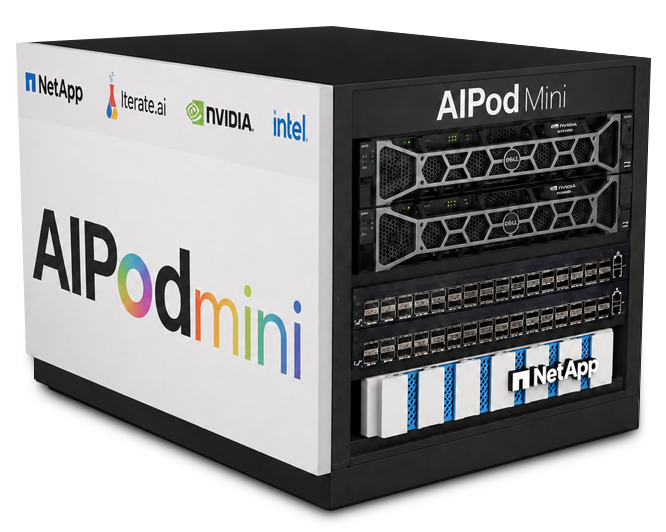
A joint educational series on private AI and the AIPod Mini. NetApp — the governed data-control layer. Iterate.ai — the private intelligence layer.