
The harder your AI works when using Public AI or shared models, the larger the bill grows.
Public AI charges you like a taxi meter that never stops running. Every question and every extra step the AI takes to think adds a few more cents to the fare. The busier your AI gets, the faster that meter spins: the more work it does, the bigger the bill. Own the car instead, and the meter disappears for good.
A 2023 chatbot task that cost $0.04 now runs ~$1.20 rebuilt as a 2026 agent: a 30× increase (EY).
The kicker: on June 1, GitHub Copilot moved every plan to usage-based billing — a monthly credit metered at list API rates for input, output and cached tokens, with overage on by default for organizations and no fallback to a cheaper model. Autocomplete stays free; the agent is what gets metered. (GitHub)
Per-token prices have fallen up to 98% a year (÷200 since 2024) — yet total AI bills keep tripling. The price cut never reaches your invoice, because three forces multiply against it:
Illustrative — framework adapted from Agora Software; price data: Epoch AI. Usage multipliers vary by workload.
Cheaper tokens just unlock more use: most of the spend is agent orchestration. The cost sits less in the prompting and more in the agent work and inference process — roughly a 1:11 ratio.
A chatbot answers once. An agent plans, fetches, checks, retries — every hidden step is another billed prompt.
Steps 2 to 4 repeat, often dozens of times. You see step 1 and step 5 and pay for everything in between — where nearly all the tokens go.
One request becomes dozens of model calls — 5–30× the tokens of a single chat, sometimes far more.
The model keeps no state between calls, so context is re-sent or re-fetched each step. Nothing is forgotten — you pay to reload it every turn.
User habits and a single pricing rule compounds costs: simple jobs get sent to premium models that cost more than the task needs, and the AI’s answers (output tokens) bill several times higher than your prompt (input).
A session grows from ~2K to ~25K tokens per call (Mem0). You pay for the prompt, answer, and everything in between.
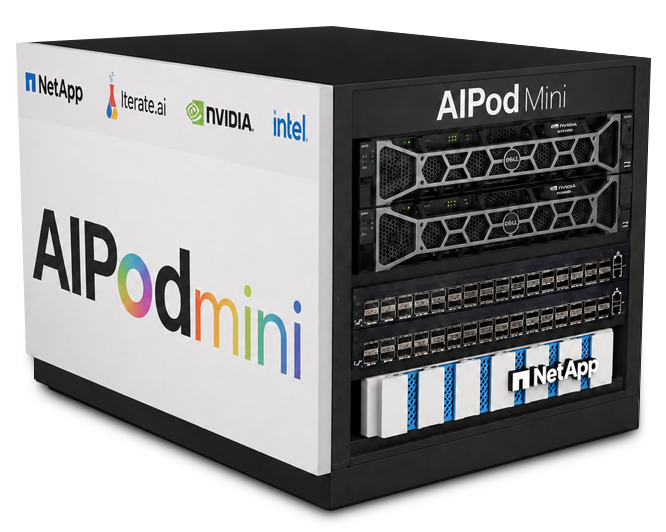
On hardware you own, token cost stops mattering: the agent loops as often as needed, and the invoice is the same.
~$118K in year one (then ~$53K/yr) vs $564K on public AI — no more token meter.
Illustrative math — Iterate.ai model for one mid-size deployment; year one includes one-time hardware. Assumptions in the full paper.
Full paper, 12 pages — iterate.ai/partners/netapp/papers. On the economics: “The Token Tax” and “The Death of the Token Tax” — Iterate.ai. Budget figures: FinOps Foundation, 2026 State of FinOps.
A joint educational series on private AI and the AIPod Mini — from NetApp and Iterate.ai.