
NetApp
/
What’s in Private AI Certified — Basic
/
What Privacy Actually Buys You
NetAppIterate.ai
NetApp Sellers & Partners
Joint Educational Series
Field Brief · Private AI

What Privacy Actually Buys You

Run AI on the AIPod Mini® and privacy is not just a safeguard: it buys security, lower cost, knowledge you keep, and an edge that your rivals cannot copy.

What you'll learn
Why privacy is a business argument, not only a security one
The four things that follow from keeping AI inside your walls
Why one cost curve keeps climbing and the other flattens
AIPod Mini with Generate’s agentic software protects your privacy

1. Security

Your data, prompts and workflows stay inside your walls. Fewer ways in means a smaller target.

3. Institutional knowledge

What your company knows stays with the company. It does not walk out with the people who leave.

Privacy
The root benefit

2. No token costs

Right-sized models on hardware you own. You pay for the box and the power, not for every question asked.

4. Competitive advantage

The way you work improves your model. It is not handed to a model your rivals also use.

Public AI = shared models
Data leaves your boundary
Every interaction is metered
Institutional knowledge can leak outward
Shared models learn from you and help others, rivals included
You rent the model and give away your intelligence.
Private AI = your own models
Data stays in your environment
Costs become predictable and flatter
What you teach the model stays yours
Your intelligence compounds inside your company
You build owned intelligence.
The buyer risks giving away knowledge, just in order to use what they bought.
Model quality scales with how much of your know-how you expose. Every prompt, correction, and eval becomes institutional knowledge the vendor (e.g., ChatGPT, DeepSeek, Claude, Grok) keeps — and you never see what it encapsulates, memorizes, and learns. The vendor can also become the rival: Anthropic’s product chief sat on Figma’s board, resigned April 14, 2026, and three days later Anthropic launched Claude Design, a competing tool.
~ Satya Nadella, Chairman & CEO, Microsoft
— “The Reverse Information Paradox,” sn scratchpad (Jul 12, 2026)
NetApp | Iterate.aiWhat Privacy Actually Buys You · 01 / 02

Two cost curves

The difference shows up again in what you pay. Shared AI bills you by the token. A token is a piece of a word — every word the model reads and every word it writes. The more useful the tool becomes, the more people use it, and the bill climbs with them.

Private AI works the other way. You buy the box once. Asking more questions does not raise the invoice, so the curve flattens instead of climbing.

Metered costs
Grow with usage
$$$$$$$$$$$$$$$
Usage / prompts
Predictable costs
Flatter as you grow
$$$$$$$$$$$$$$$
Usage / prompts
The trap in tokenomics

The price of a single token keeps falling. Bills still go up, because everyone — and every agent — uses more. Meta staff were reported to have run through 73.7 trillion tokens in one month, tracked on an internal leaderboard. Outside analysts put that near $221M for the month — about $2.65B a year. Cheaper per token did not mean a cheaper bill.

AIPod Mini makes AI your business asset, not knowledge shared with rivals

Private AI running on your AIPod Mini turns a model from a running cost into a business asset. It guards the data. It lowers what you pay over time. It keeps your company’s memory in your building. And it widens the gap between you and everyone renting the same shared model.

Further reading
On the cost curve
“The Token Tax” — Iterate.ai
Both from Intelligence Unshared: The AI Sovereignty Papers
On what the model keeps
sn scratchpad, Jul 12, 2026
About this series

A joint educational series on private AI and the AIPod Mini. NetApp — the governed data-control layer. Iterate.ai — the private intelligence layer.
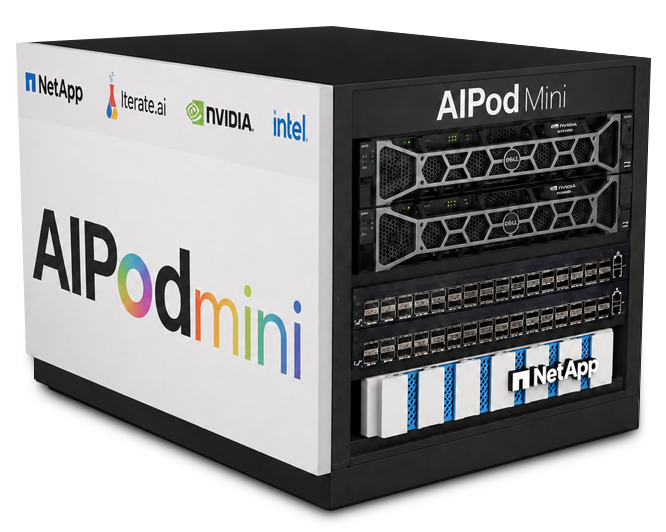
NetApp AIPod Mini
NetAppIterate.ai
v1.1 · Aug 10, 2026
NetApp | Iterate.aiWhat Privacy Actually Buys You · 02 / 02