
The most common objections to running AI privately are all cost objections in disguise — and all three rest on outdated numbers.
Most enterprise buyers picture AI the way the largest cloud and model providers describe it. That picture is not wrong so much as incomplete — it reflects the economics of organizations that have committed enormous capital to centralized infrastructure, and whose products are designed around it. The scale of that commitment explains why the public conversation sounds the way it does.
Builders — land, shell and construction labor. Energizers — power, cooling, electrical and mechanical plant. The chart counts hardware only, never the software that makes it useful. Source: Goldman Sachs; S&P Capital IQ; McKinsey Data Center CapEx TAM & Demand model.
Four myths follow from that picture.
“Private AI requires millions in GPU infrastructure”
One server node with 8 NVIDIA H100 chips costs $300K–$400K. A full water-cooled rack runs $1.2M or more. So private AI is out of reach for most companies.
Right-sized models run most business work on $10K–$20K of NVIDIA RTX Pro cards. No water cooling. No data-center build. That is 60–300× lower cost for the same result.
A CTO said he could not do private AI because he could not afford hundreds of thousands in GPUs. We showed him a $15K workstation running his own use case. The objection went away.
“You need a giant, frontier-scale model to do the job”
Only the giants are good enough for real work. Those are the models with hundreds of billions of parameters, sold as steps toward human-level AI. Anything smaller is a toy.
Small language models (0.5B–35B) trained for one job match or beat the giants on that job, for far less. The smallest run on handheld devices. The rest run on hardware you own.
Two things keep buyers on a hosted giant: doubt a smaller model is good enough, and cost. Right-sizing removes both.
“Every query keeps the token meter ticking up”
AI is billed per token, forever. Costs rise with every prompt and every user, so heavy use becomes a permanent tax on adoption.
Generate runs on hardware the customer owns. No per-token metering — buy once, and inference is effectively unmetered. Usage can grow without a rising bill.
Metered cloud AI ties the vendor's revenue to your usage. Owned inference ties it to outcomes. For always-on workloads that is often the difference between a pilot and a rollout.
“Our data is too messy for AI”
AI needs a tidy library where every book is shelved. Our files are a closet nobody has opened in years, so we are not ready.
Gartner puts roughly 80% of enterprise information in that closet. Reading and organizing it is exactly what an agentic layer is built to do.
The closet is not the obstacle — it is the reason. Gartner, Navigating the Solutions Landscape for Managing Documents, Feb 2026.
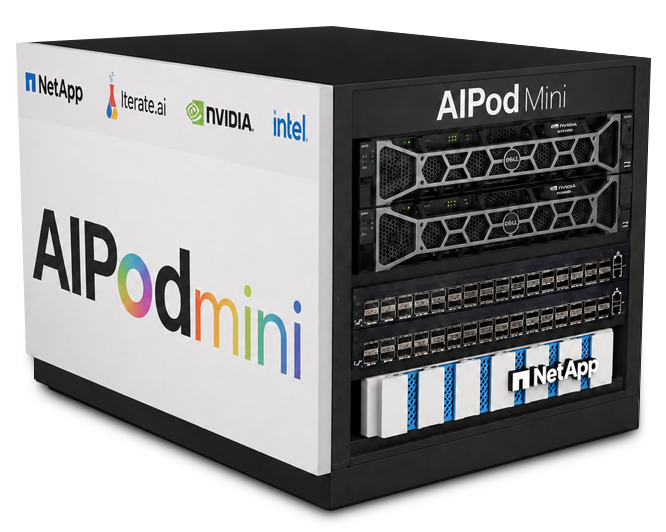
A joint educational series on private AI and the AIPod Mini. NetApp — the governed data-control layer. Iterate.ai — the private intelligence layer.