
NetApp
/
What’s in Private AI Certified — Expert
/
From Empty Infrastructure to Working AI in 20 Minutes (Deep Dive)
NetApp Iterate.ai
NetApp Sellers & Partners
Joint Educational Series
Field Brief  ·  Paper Four of the Series

From Empty Infrastructure to Working AI in 20 Minutes

Why data readiness is the real deployment bottleneck — and how the AIPod Mini unlocks the dark storage sitting in NetApp® ONTAP.

What You’ll Learn
Why enterprise AI stalls at the data layer, not the model layer.
How the AIPod Mini collapses a 13-week build into ~2 hours to governance-ready.
What native ONTAP integration unlocks that Azure, Bedrock, and Vertex can’t reach.
A framework for assessing whether an organization’s data is ready for AI.
Written by Jon Nordmark (Iterate.ai CEO) with support from
Brian Sathianathan (Iterate.ai President, CAIO)
and the NetApp AI Solutions Team
Version 1.2
Aug 11, 2026  ·  01 / 14
Same Destination, Two Timelines

13 Weeks of Custom Engineering — or ~2 Hours to Governance-Ready

Every enterprise AI project runs the same milestones: stand up infrastructure, install the platform, connect the data, validate governance, ship an agent. A ground-up custom build spreads them across a quarter of engineering. Once IT completes the standard Kubernetes and ONTAP setup that any enterprise AI platform requires, the AIPod Mini — NetApp infrastructure and Iterate’s Generate software, pre-integrated — gets you from there to governance-ready in about two hours, not weeks.
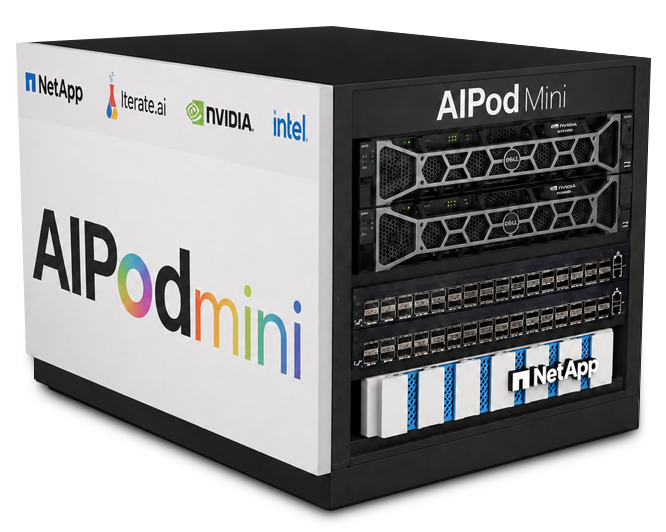
The NetApp AIPod Mini appliance
Traditional blueprint
9–12 weeks  ·  ~2,016 hrs
Wk 2–8
Wk 9–12
The AIPod Mini
~2 hrs
weeks of engineering eliminated
Both bars share one timescale — the AIPod Mini’s two hours is a hairline against a quarter of engineering. Standard infrastructure setup is a prerequisite either way.
Milestone
Traditional Approach
AIPod Mini
Physical setup
Week 1. Hardware arrives, racked, and configured. (~10,080 min)
Hour 1. Unbox, rack, and power on (30–60 min).
Software install
Wk 2–4. Platform setup, dependencies, integration planning.
Hour 1–2. Generate installed and validated (15–20 min).
Connect data
Wk 5–8. Data hunting, custom connectors, ETL pipelines. (~40,320 min)
Hour 2. Point Generate at sources; connectors handle the rest (20 min).
Governance validation
Wk 9–12. Security reviews and hand-built access controls. (~40,320 min)
Hour 2+. Existing RBAC carries through; ready for review.
Ship first agent
Wk 13+. If still not working — the project often stalls here.
Days, not weeks. Super Agent builds a working agent from a prompt, post-approval.
NetApp | Iterate.aiFrom Empty Infrastructure to Working AI  ·  02 / 14
The Competitive Set

What “Traditional” Even Means Now

Enterprise AI is barely two years old, so there is no single “traditional” path. Customers are weighing three — and all three hit the same wall: data readiness.

The AIPod Mini is the only one with native NetApp ONTAP integration — on tap access to the dark, unstructured data most AI never reaches, kept fully private on your own AI model and GPU hardware, protecting your data and your strategies. ONTAP is the governed data-control layer; Generate is the intelligence layer where that data becomes answers, appeals, recommendations, and decisions. (See Key Terms, p. 14.)

Approach
Setup Time
Real Bottleneck
AIPod Mini Advantage
Public Cloud AI
Azure OpenAI, Bedrock, Vertex
2–4 weeks to pilot
Data egress policies, compliance blocks, token tax
Data stays on-prem; native ONTAP integration; no token costs
Hyperscaler “AI Appliance”
Dell, HPE, Lenovo
2–4 weeks
Custom connectors; no native ONTAP; generic RAG
Pre-built connectors; snapshot ingestion; dark-storage unlock
Custom Build
DIY RAG stack
13+ weeks (if ever)
Everything — data, governance, integration
Turnkey; ~2 hours to governance-ready vs. months of engineering
How to Say It

“Most enterprises face one of three paths — and all three stall on data readiness. The AIPod Mini is the only option with native NetApp ONTAP integration: your data never leaves your infrastructure, snapshot ingestion unlocks your dark storage without custom ETL, and you’re governance-ready in hours instead of quarters.”

NetApp | Iterate.aiFrom Empty Infrastructure to Working AI  ·  03 / 14
A True Story

A Partner’s Success

In a NetApp partner training session on July 7 2026, a senior leader at one of the world’s largest technology solutions providers made this statement:

“Iterate was able to get a healthcare vaccine recommendation use case operational within one day — compared with other AI blueprint approaches that took weeks.”

And this wasn’t just a demo or a proof of concept — it was a working AI system, connected to real data, delivering real business value.

That matters because the comment came from a highly experienced partner: a global technology solutions provider, systems integrator, and value-added reseller with more than 12,000 employees and deep relationships across the Fortune 100.

The question every NetApp seller should ask is: how? The answer isn’t faster hardware or better models. It’s data readiness — and data/strategy protectedness.

NetApp | Iterate.aiFrom Empty Infrastructure to Working AI  ·  04 / 14
The Enterprise AI Deployment Reality

How Most AI Projects Actually Go

Week 1
Excitement. The AI platform arrives. Leadership is energized. The team is ready.
Wk 2–4
Data hunting. Where is the data? Who owns it? What format? Can we access it? Do we have permissions?
Wk 5–8
Integration bottleneck. Custom connectors. API development. Data pipelines. ETL jobs. Security reviews.
Wk 9–12
Risk of stalling. Without AI-ready data, the AI has infrastructure but limited intelligence — it may not see the documents, databases, and systems that hold the knowledge it needs.
“95% of enterprise generative-AI pilots never reach measurable business impact.” MIT, 2025.
That stalled outcome — infrastructure without intelligence — is what the AIPod Mini is built to remove.
27%
of enterprise AI failures are caused by critical knowledge that was never captured or stored (2026 research).
60%
of AI projects lacking AI-ready data foundations will be abandoned through 2026 (Gartner).
NetApp | Iterate.aiFrom Empty Infrastructure to Working AI  ·  05 / 14
The Core Idea

What “AI-Ready Data” Actually Means

Most customers think their data is ready for AI because it exists — it’s in SharePoint, databases, file shares, somewhere. But “exists” is not the same as AI-ready. Most enterprise data estates fall short on at least three of these five criteria — which is why AI projects stall.

1
Discoverable
The AI finds it without manual mapping — it knows what data exists, where it lives, and what it contains.
2
Accessible in real time
The AI reads it now — not after a six-week ETL project. No migration, no copying, no waiting.
3
Governed by one identity & policy model
The AI respects existing permissions. If a user can’t see a file, the AI can’t either.
4
High quality
Structured enough for the AI to understand. Not perfect, not pristine — but usable.
5
Provisioned as reusable products
Consumable across every system in the estate — on-prem and cloud — without moving or copying it first.
The Connector Advantage

Generate connects to dozens of enterprise data sources out of the box — so the AIPod Mini doesn’t arrive empty. It arrives ready to connect.

SharePointGoogle DriveDropboxMicrosoft 365SQL / PostgreSQL / OraclePDFs & documentsNetApp ONTAP — native snapshot ingestionEnterprise apps & APIsCustom sources
NetApp | Iterate.aiFrom Empty Infrastructure to Working AI  ·  06 / 14
The Biggest Differentiator

Unlocking Dark Storage

The value proposition most sellers miss: the AIPod Mini turns your customer’s dark storage into live intelligence. Most enterprises have a data iceberg — and the vast majority of it is dark.

10–20%
“Hot” — actively used, indexed, searchable
80–90%
“Dark” — stored, but not searchable, not indexed, not accessible
What’s Buried in the Dark
Contracts from 5–10 years agoArchived, unsearchable emailReports from past projectsCustomer records in legacy formatsCompliance retention docsEngineering specs from old lines
It cost millions to create, holds critical institutional knowledge, and is required for compliance — but nobody can use it, because it’s not indexed, sits in legacy formats, and lives in ONTAP volumes applications can’t easily query.
How the AIPod Mini Unlocks It
Native ONTAP integration
Ingests via snapshots — no moving or copying. Reads archived volumes and preserves permissions.
AI-powered ingestion
Reads PDFs, Word docs, email, spreadsheets, scanned images (OCR); understands context; builds a vector database.
Query across decades
Agents search 2015–2025 contracts, reconstruct decision history from email, and surface never-indexed compliance docs.
You don’t want public AI (shared models) touching your private, stored data. Here’s why:
“If you use public AI (shared models), you pay for AI intelligence twice. Once with money, and again with something far more valuable — the institutional knowledge you must reveal to make that intelligence useful.” — paraphrasing Satya Nadella, CEO, Microsoft, The Reverse Information Paradox
The Reverse Information Paradox
Jul 12, 2026  ·  In the age of intelligence, how should firms protect their core IP?
Satya Nadella has issued a shocking warning to companies using AI
Julie Bort  ·  Jul 13, 2026  ·  The concern is that, as startups and enterprises use AI models from labs like OpenAI and Anthropic, the labs gain ever-increasing access to those companies’ most sensitive business information
NetApp | Iterate.aiFrom Empty Infrastructure to Working AI  ·  07 / 14
The NetApp-Specific Advantage

What Azure, Bedrock & Vertex Can’t
— and Shouldn’t — Do

Two problems, not one. Can’t: none of them have native NetApp ONTAP integration, so they can’t reach your dark storage without custom ETL. Shouldn’t: they’re shared, public LLMs — routing contracts, records, and IP to them sends your most sensitive data off your infrastructure. The AIPod Mini answers both.

Snapshot Ingestion
Ingest directly from NetApp snapshots without moving or copying files. No migration project, no corruption risk, no storage duplication — ingestion in minutes, not weeks.
SnapLock Audit Trails
For finance, healthcare, and government, Generate integrates with SnapLock for immutable audit trails of what data the AI accessed and when — audit-ready from day one, no manual logging.
FlexClone Testing
Test agents on production data safely — without risking the live environment. Validate accuracy before deployment, with no need for synthetic test data.
Discovery

Dark Storage Questions to Think About

1
“How much data do you have in NetApp ONTAP that’s more than two years old?” Terabytes or petabytes = dark storage waiting to be unlocked.
2
“Can your teams search that old data today?” “No” or “only with manual review” is the pain point.
3
“What’s in that old data?” Contracts, emails, reports, IP filings — tells you which use case to lead with.
4
“Have you ever needed to find something in it and couldn’t?” Surfaces the business pain.
5
“What would it be worth to make all that data searchable by AI?” Frames the ROI conversation.
NetApp | Iterate.aiFrom Empty Infrastructure to Working AI  ·  08 / 14
Real-World Dark Storage Use Cases

Four Ways the Dark Data Pays Off

Contract Intelligence
10,000 vendor contracts spanning 15 years sit in ONTAP. Nobody knows what’s in them — not even “which vendors auto-renew?”
Generate ingests all 10,000 via snapshots and deploys a Contract Intelligence Agent. Procurement asks “Which contracts auto-renew in Q3 2026?” and gets names, vendors, dates, and pricing — in seconds.
15 years of dark contracts → queryable. No manual review.
Institutional Knowledge Recovery
A manufacturer lost its lead engineer. Design decisions from 2018–2022 are buried in archived email and old project folders.
Generate ingests PST files and project folders and deploys a Knowledge Recovery Agent. “Why did we choose aluminum over steel in 2020?” surfaces the original thread, report, and cost analysis.
Recovers lost knowledge. Prevents costly re-work.
Compliance & Audit Readiness
A financial firm faces an audit. Regulators want all communications on a 2019 transaction — buried in archived email and file shares.
A Compliance Search Agent returns a complete audit package with source citations and SnapLock audit trails from a single natural-language query.
A 6-week manual review → a 6-minute AI query.
M&A Due Diligence
An acquisition requires reviewing 20 years of contracts, IP filings, and customer agreements — stored in ONTAP but not indexed.
A Due Diligence Agent surfaces every IP licensing agreement and flags change-of-control clauses with risk indicators.
Due diligence from months → weeks.
You don’t want public AI (shared models) touching your private, stored data. Here’s why:
“If you use public AI (shared models), you pay for AI intelligence twice. Once with money, and again with something far more valuable — the institutional knowledge you must reveal to make that intelligence useful.” — paraphrasing Satya Nadella, CEO, Microsoft, The Reverse Information Paradox
NetApp | Iterate.aiFrom Empty Infrastructure to Working AI  ·  09 / 14
The 20-Minute Deployment

What Actually Happens

When a customer says “we want AI,” they mean: AI that can answer questions about our business, using our data, without exposing it to the public cloud. Here’s how the AIPod Mini delivers that in under 20 minutes.

Min 1–5
Unbox and power on A turnkey appliance — NetApp infrastructure + Generate software, pre-integrated. No assembly required.
Min 6–10
Connect to data sources Point Generate at SharePoint, Google Drive, databases, and ONTAP volumes. Connectors handle the rest — no custom code, no API development, no ETL.
Min 11–15
Set permissions Generate honors existing access controls. RBAC carries through from source systems to AI outputs — if a user can’t see it, the AI won’t surface it.
Min 16–20
Deploy your first agent Use Generate’s Super Agent: describe what you want — “an AP Agent that finds duplicate invoices and pricing discrepancies” — and it builds the agent, prompts, workflows, and configuration automatically.

By minute 20: a working AI agent, connected to real data, ready to deliver value. No data scientists. No months of integration. No custom development.

Why This Matters for Regulated Industries

Data never leaves the customer’s infrastructure. Generate reads SharePoint in place, processes locally on the AIPod Mini, and returns results — all inside the customer’s environment. That means HIPAA (PHI stays on-prem), GDPR (PII never crosses borders), FedRAMP-ready data sovereignty, and traceable audit trails. Fast deployment without data egress is the entire value proposition.

NetApp | Iterate.aiFrom Empty Infrastructure to Working AI  ·  10 / 14
The Real-World Proof

What Customers Are Achieving

Healthcare
$17.4M
recovered from denied insurance claims — more than 10× ROI.
Under one week to production.
Accounts Payable
$122K
recoverable from sample data — duplicate invoices, unapplied credits, pricing gaps.
One day to deploy.
Federal
Policy search
natural-language search across regulations, permits, and compliance docs.
One day for eval environment.
Before You Position

The Data Readiness Checklist

That speed only works if the data is accessible. Ask these five questions before the sale, not after.

1
Where does your most valuable data live?
SharePoint, databases, ONTAP, enterprise apps, file shares? “Not sure” is a red flag — they need discovery first.
2
Can your teams access it today?
If users can’t access the data, the AI can’t either.
3
Structured or unstructured?
Generate handles both — but unstructured data may need OCR or preprocessing.
4
Does the data need to stay on-premises?
HIPAA, GDPR, FedRAMP, sovereignty? If yes, the AIPod Mini is the fit — public AI means the token tax.
5
What business outcome are you chasing?
Revenue recovery, productivity, compliance automation? No clear outcome — the project stalls, even with perfect data.
NetApp | Iterate.aiFrom Empty Infrastructure to Working AI  ·  11 / 14
Evaluating Fit

A Strategic Framework for Data Readiness

Whether the AIPod Mini is the right fit comes down to one question: is the underlying data ready for AI? The framework below walks through how to answer that.

Start With the Dark Storage Question
How much data sits in NetApp ONTAP that’s more than two years old — and how much of it can teams actually search or analyze today?
Most organizations find the honest answer is “a lot, but nobody can find anything in it.” That gap is the dark storage problem, and it’s the starting point for the rest of the assessment.
What’s at Stake
Dark storage is typically 80–90% of an organization’s total data. Generate connects directly to ONTAP and ingests it via snapshots without moving it, so it becomes queryable by agents in minutes — letting teams search years of contracts or respond to audits in minutes instead of weeks.
Assess Readiness
Walk the data readiness checklist on the previous page. Data silos, access-control gaps, compliance requirements, and unclear outcomes each shape how the first agent should be scoped.
Where the AIPod Mini Differs
Its distinct advantage is native access to dark storage: Generate connects directly via NetApp snapshots and makes that data queryable by agents. Azure OpenAI, AWS Bedrock, and Google Vertex don’t have native ONTAP integration, so none can reach it the same way. Pre-built connectors also take deployment from unboxing to a working agent in under 20 minutes, not 20 weeks.
A Reference Point
World Wide Technology went from zero to a working vaccine-recommendation agent in one day — a timeline other AI blueprint approaches typically measure in weeks.
The Takeaway
Readiness for AI is rarely a question of ambition — it’s a question of data. Once the sources are identified, whether SharePoint, Google Drive, or ONTAP volumes, a working agent is typically days away, not months.
NetApp | Iterate.aiFrom Empty Infrastructure to Working AI  ·  12 / 14
The treasure already in ONTAP

Enterprise AI Fails at the Data Layer, Not the Model Layer

Your customers have spent decades accumulating knowledge in SharePoint, databases, and enterprise apps. But the biggest treasure is sitting in their NetApp ONTAP volumes — dark storage nobody can search. That’s 80–90% of their data: contracts, archived email with decision history, past reports, legacy customer records, never-indexed compliance docs, and IP documentation.

The AIPod Mini + Generate unlocks it in 20 minutes.
No data migration. No custom integration. No months of professional services. Just point Generate at NetApp ONTAP, ingest via snapshots, and deploy agents.

The companies that recognize dark storage is their biggest untapped asset will move from pilot to production in days, not years. The ones that don’t will spend six months building custom connectors to reach only their “hot” data — missing 80–90% of their institutional knowledge. The dark storage is ready. The connectors are built. The agents are waiting.

Better Together
Infrastructure alone doesn’t deliver AI. Neither does software. Working AI happens where the two meet.
NetApp
The governed data-control layer — ONTAP stores, secures, and keeps your dark storage private and on-prem.
Iterate.ai
The private intelligence layer — Generate turns that data into agents, answers, and decisions in minutes.
About This Series

A joint educational series on private AI and the AIPod Mini. NetApp — the governed data-control layer. Iterate.ai — the private intelligence layer.

NetAppIterate.ai
v1.2 · Aug 11, 2026
NetApp | Iterate.aiFrom Empty Infrastructure to Working AI  ·  13 / 14
Reference

Key Terms

The distinction that matters most: NetApp ONTAP is the data-control layer — where enterprise data is stored, secured, and governed. Iterate’s Generate is the intelligence layer — where that data is turned into answers, workflows, and decisions. ONTAP makes dark data reachable; Generate makes it useful.

NetApp ONTAP
Unified data-management software for file and block workloads across flash, disk, and cloud/object storage. It stores, secures, and governs enterprise data — it does not, on its own, understand or index all of it.
Flash storage
Solid-state (SSD) storage that ONTAP manages alongside disk and cloud. Fast, low-latency access — the performance tier where “hot,” frequently-used data typically lives.
Dark data
Unstructured, underused enterprise data: PDFs, contracts, emails, claims, images, tickets, call transcripts, manuals, logs, file shares. ONTAP can hold or expose it, but it becomes useful only once it is scanned, classified, indexed, permissioned, and connected to AI.
NetApp Data Classification
AI/NLP services that scan and classify data across hybrid multicloud — for compliance, sensitive-data detection, cost optimization, migration, and preparing data for GenAI and RAG.
NetApp AI Data Engine
Transforms unstructured data into structured, AI-ready datasets for machine-learning and generative-AI workloads — the bridge that helps illuminate dark data.
RAG (Retrieval-Augmented Generation)
A technique where an AI model retrieves relevant enterprise data at query time and grounds its answer in it — so responses reflect your own documents, not just the model’s training.
Generate (Iterate.ai)
Iterate’s private-AI intelligence layer. Reasons over your ONTAP data with agents, RAG, workflows, and permissions — privately, without sending data to a public frontier model.
NetApp | Iterate.aiFrom Empty Infrastructure to Working AI  ·  14 / 14