

Understanding the five layers of AI memory — and why governing them is the real competitive question.
A joint educational white paper by NetApp® and Iterate.ai.
On the Big Technology Podcast (Dec 18, 2025), with Alex Kantrowitz, OpenAI CEO Sam Altman argued that the next transformative advance would be AI with effectively unlimited personal memory — and that today’s systems are only at the beginning of it.
Altman isn’t being cautious about this — by his own account, it’s one of the parts of AI’s future he’s most excited about. And he’s not wrong that it will unlock capabilities we haven’t yet imagined. But every one of those capabilities compounds a governance challenge we haven’t yet solved.
Now imagine that memory persisting not within a single user’s sessions, but across an entire organization — departments learning from each other, workflows improving, institutional knowledge compounding — inside a third-party system your competitors also use. Your CFO’s pricing models, your R&D pipeline, your logistics rethinks, all stitched together by an LLM everyone else rents too.
Organizations are becoming organisms, and AI memory is their nervous system. Right now, for most companies, that nervous system is rented — hosted on someone else’s servers, learning patterns across every company that uses it. The risk isn’t just that data leaks. It’s that the system learns to see patterns across organizations — and you have no way to know when a competitor’s question just got answered with your company’s learning.
On July 12, 2026, Microsoft CEO Satya Nadella published a warning about a fundamental asymmetry in how shared AI systems learn: the value flows one way — toward whoever owns the infrastructure, not whoever created the knowledge.
Models learn from “exhaust”: the prompts you write, the tools your agents call, and the corrections you make when the model is wrong. That exhaust becomes institutional knowledge — the kind a competitor could never buy.
The knowledge flows out. Only the shared infrastructure keeps what it learns.
Most boards still picture AI memory in twentieth-century terms — data in a database, with retention policies and access controls. That’s part of the picture, but not the whole one: the five layers below actually split into two categories most people don’t realize are different.
Layers 1–3 (Working, Conversational, Semantic) live outside the model — the current prompt, a chat history, a document store it queries via RAG. Swap out the database tomorrow and the model behaves identically. Layers 4–5 (Behavioral, System-Level) are different: they get baked into the model itself, through training — permanent, not swappable. Until you can see the whole stack, governance stays dangerously vague.
The real risk isn’t any single layer — it’s how they interact. When all five are active at once, the biggest governance risks emerge. Watch one ordinary action move through the entire stack.
An elephant returns to a watering hole decades later, finding what thirst taught it to remember. But memory isn’t data in a filing cabinet. It is rebuilt each time we recall it, shaped by emotion, experience, and everything that has happened since.
Tom Mustill, biologist and author of How to Speak Whale, has explored the remarkable world of whale communication. Humpbacks sing complex songs of repeating rhythms and phrases. But the songs aren’t fixed. They change.
A new phrase can catch on. Other whales hear it, learn it, alter it, and carry it across thousands of miles. No sheet music. No Spotify. No written language.
Researcher Ellen Garland has documented how these songs spread culturally from whale to whale and population to population. Old songs disappear. New ones emerge. The song survives, but not unchanged.
Memory is reconstruction, not recording.
Humans experience something equally remarkable with music. A beloved song from our teenage years can sometimes reach memories that seem otherwise inaccessible. For someone living with Alzheimer’s, names and dates may fade. Ordinary conversation may become difficult.
Yet a familiar melody can find a door that words cannot.
Eyes brighten. A smile appears. A foot starts tapping. Someone distant moments earlier may suddenly sing, sway, or even dance.
The documentary Alive Inside: A Story of Music and Memory captured this beautifully. An elderly man sits withdrawn and slouched over. Then he hears music he loved when he was young. His head rises. He smiles. He sings. He moves.
For a moment, the years seem to fall away.
AI can stitch together the workflows, decisions, corrections, and accumulated judgment of your CFO, head of R&D, pricing analyst, and supply-chain lead. It can hold those memories across months and years, connecting events and discovering patterns no single person could see.
That becomes institutional muscle memory.
But what happens when that memory lives outside your walls, inside a system whose inner workings even its creators cannot fully trace or explain — much like the extraordinarily complex memory systems of humans, elephants, and whales? What happens when your strategic roadmaps, pricing logic, hidden vulnerabilities, and next moves fall outside the control of your board and corporate officers?
Who governs your company’s memory then? Someone you don’t know? Someone you’ve never met?
The memory stack forces one question: in whose infrastructure do your five layers live? On shared, public models, the deepest layers — Behavioral (Layer 4) and System-Level (Layer 5) — accrue to the infrastructure owner, and your intelligence exhaust becomes everyone’s. Private AI keeps all five layers inside infrastructure you own. That is what the AIPod Mini is built to do.
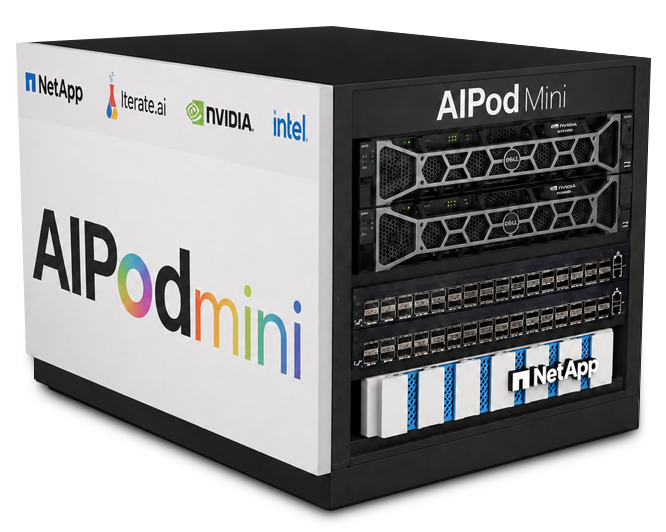
NetApp has long been the place where an organization’s memory lives — documents, transactions, histories, decisions, and years of accumulated data, securely stored but often difficult to fully access or connect.
Iterate.ai’s Generate activates that memory.
Much like a familiar song can unlock memories that seemed inaccessible, Generate can reach into stored enterprise data, connect what was fragmented, and turn it into answers, agents, and decisions.
NetApp preserves the memory. Generate helps the organization recall, connect, and act on it.
Memory is the point where AI stops being a tool you use and starts becoming infrastructure you depend on. Altman is right that it will be transformative; Satya is right that, on shared models, it flows one way — away from you. The organizations that win won’t be the ones with the most memory. They’ll be the ones that own theirs — every layer, on their own infrastructure, governed like the asset it is.
The opportunity is bigger than AI remembering. It is giving organizations the ability to own what their AI learns.
When that memory stays inside your infrastructure, every interaction, correction, workflow, and insight can compound into a proprietary advantage.
Private AI on the AIPod Mini keeps all five layers inside your walls — secure, governed, and working for you.
A joint educational series on private AI and the AIPod Mini. NetApp — the governed data-control layer. Iterate.ai — the private intelligence layer.
Plain-language definitions for the memory and governance terms in this paper — enough to hold the conversation with a technical team.