Research paper from Iterate.ai

The Half-Life of an AI Strategy

AI moves in dog years. A strategy has a half-life. This 26-page paper shows how fast the clocks are running, what that does to five-year plans, company data, and board oversight, and how leaders can respond.

In two years, the longest task AI finishes reliably went from 4 minutes to 12 hours.

4 minutesMar 2024About 90 minutesMar 202512 hoursMar 2026

Longest software task AI completes reliably, by model release. Circle area shows task length. Source: METR / Anthropic, 2026.

The same level of AI performance gets about 13 times cheaper every year.

100TodayAbout 8In 1 yearUnder 1In 2 years

Illustration of the measured pace since 2023, held constant: cost today = 100, circle area shows cost. Source: Epoch AI. Not a forecast.

AI’s working memory grew from 5 pages to 25,000 in under five years.

5 pagesJun 20202,500 pagesFeb 202425,000 pagesApr 2025

Largest context window at each milestone, in pages of text. Circle area shows size. Sources: OpenAI, Google, and Meta model releases.

  • Why AI changes 5 to 10 times faster than retail, banking, cars, and drugs, and what dog years and half-life each explain
  • What a $5 million AI investment looks like when a new model does the same work for a tenth of the cost
  • How memory, inference, and agents change what a board has to govern
  • Four habits and two controls for leaders who plan in a market that changes in months
Thank you!
Your submission has been received!
Here's your digital copy of The Half-Life of an AI Strategy.
Download White Paper
Oops! Something went wrong while submitting the form.

What is inside the paper

Sources are named, and estimates are labeled as estimates.

5 to 10×

How much faster key AI technologies change than mature industries, with the evidence behind the range and up to about 20× on some measures.

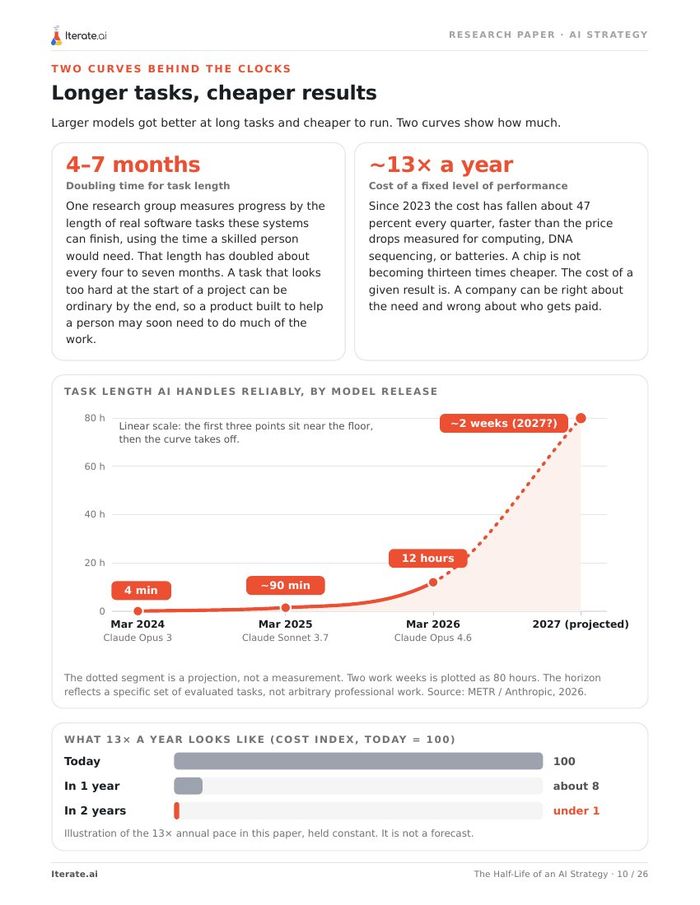
5,400×

How much faster an image model trained to the same accuracy, from 10 days to 2 minutes 43 seconds in 19 months, and why the transformer matters.

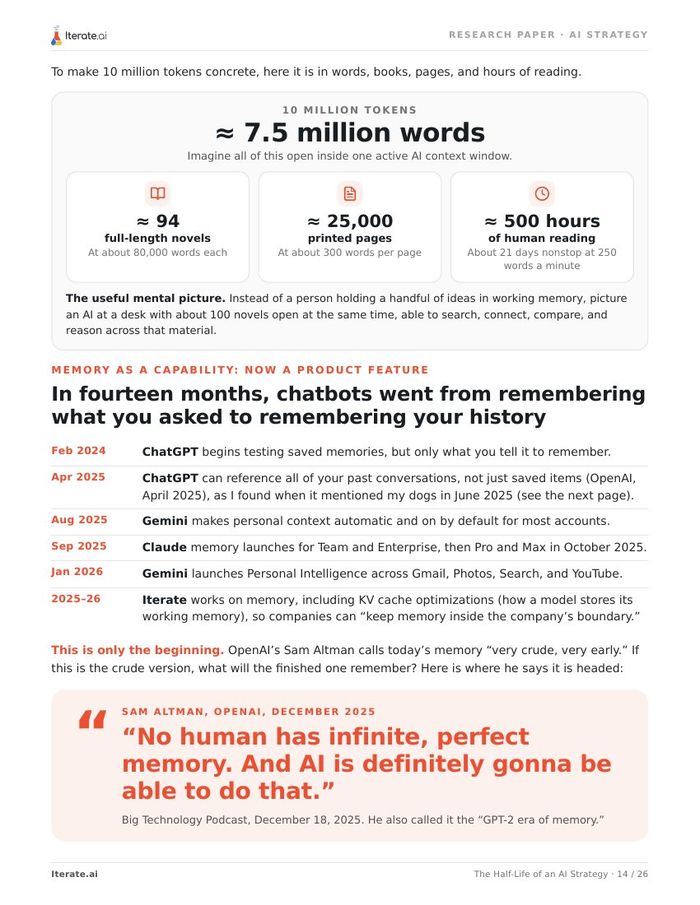
13× a year

How fast the cost of a fixed level of AI performance has been falling, and what that does to a five-year payback.

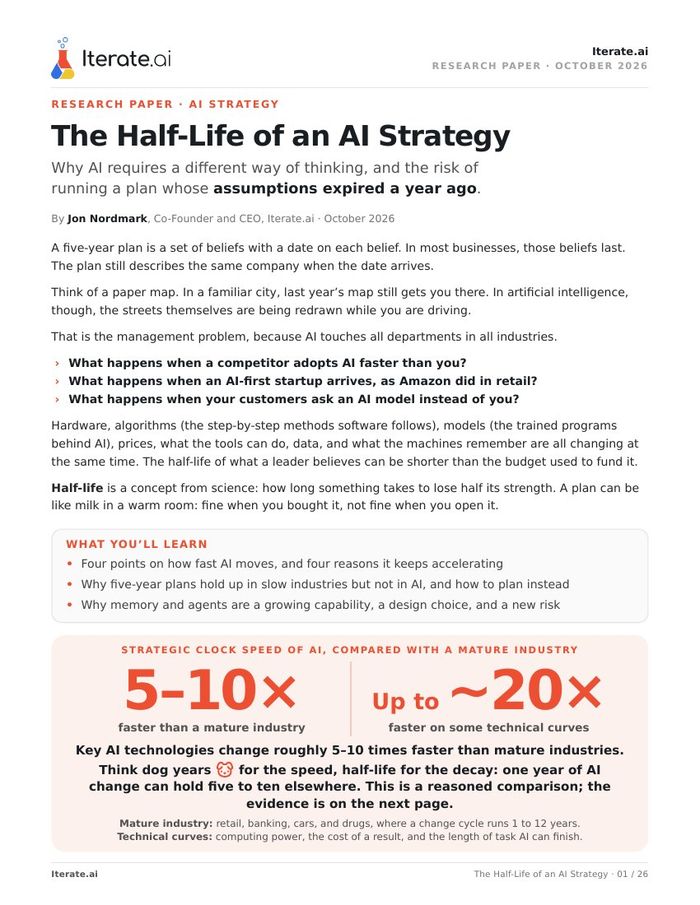
7.5 million words

What a 10-million-token context window can hold, and why AI memory is a capability, a design choice, and a risk.

About 6 months

How long three 2026 incidents took to move AI agents from human-run to self-directed, and what a board should ask.

61 to 18 years

How the average stay in the S&P 500 shortened between 1958 and 2012, and why Kodak and Blockbuster had more warning than you do.

A look inside

Four of the 26 pages. The rest is in the full paper.
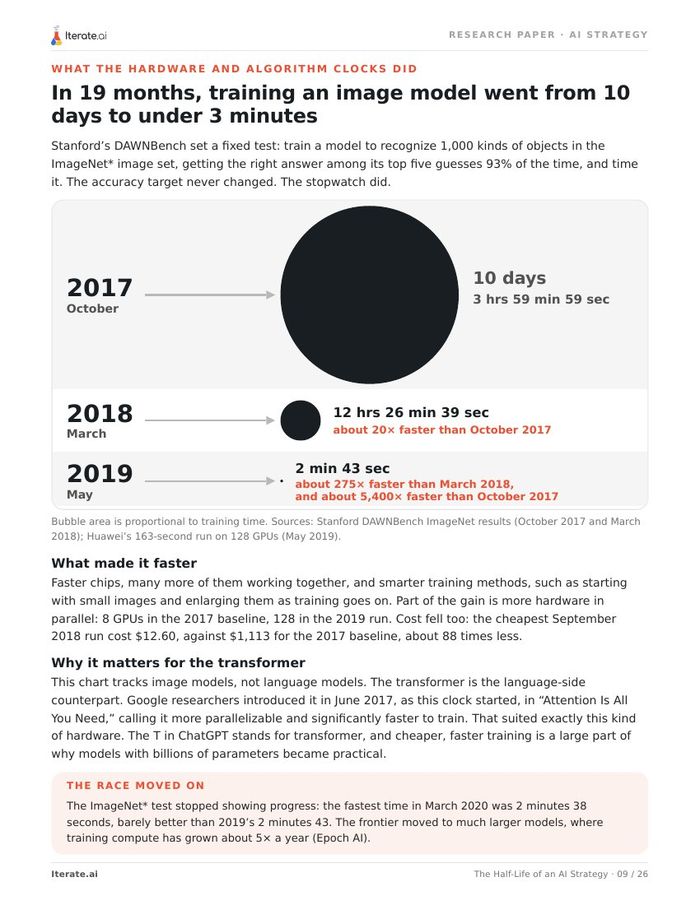
Page 1 of the paper: the title, Jon Nordmark's byline, a 'What you'll learn' box, and a callout saying AI changes 5 to 10 times faster than mature industries.
The cover: dog years for the speed, half-life for the decay.
Page 9: bubble chart of image-model training time falling from 10 days in 2017 to 12 hours in 2018 and 2 minutes 43 seconds in 2019.
Ten days became under three minutes in 19 months.
Page 10: chart of AI task length rising from 4 minutes in 2024 to 12 hours in 2026, and bars showing cost falling about 13 times a year.
Longer tasks, cheaper results: two curves behind the clocks.
Page 14: 10 million tokens shown as 7.5 million words or about 94 novels, plus a timeline of chatbot memory features from 2024 to 2026.
7.5 million words of working memory, and a 14-month timeline.

Written by someone who planned in years

Jon Nordmark is Co-Founder and CEO of Iterate.ai, a private AI software infrastructure company, and co-founded eBags.

Earlier in his career he was a product manager at Samsonite, where product development took about 18 months and he updated three-year plans for about 1,000 products every quarter. eBags, his first startup, which he co-founded in 1998, had to change marketing plans every six months as it worked its way to selling 29 million pieces of luggage. Today his company, Iterate.ai, works in weeks. That gap is the subject of this paper.

Questions

Is the paper free?

Yes. Enter your name, email, and company, and you can download the PDF or read it on the web right away.

What do you do with my email?

We use it to deliver the paper. If you tick the box, we also send occasional Iterate.ai research and updates, and you can unsubscribe at any time. Details are in our Privacy Policy.

Who should read it?

CEOs, board members, CIOs, and strategy and finance leaders who make multi-year commitments in a market that changes in months.

Can I share it?

Please share this page, so colleagues can get their own copy.

Your strategy has a half-life. Find out how long.