
There are three categories of AI providers.Many providers offer free AI serrvices within a limited window in exchange for training that AI on all the consumer usage. Others offer some levels of segmentation in a “private” cloud or a promise to not train on user’s data. Only one type of provider keeps the model, the hardware, the stored data, the memory, and everything the system learns under your control. Very few providers can operate in the first column.
| True Private AI | “Private” cloud & vendor-managed |
Public AI / shared | |
|---|---|---|---|
| Where it runs | Entirely on machines you own | Vendor's models, partly walled off hardware | Shared models and shared data on shared chips |
| Who controls the data | You do, completely | Depends on the vendor | You don't |
| Cost per question | None — you own the box | Per token, plus egress fees | High and hard to predict |
| Works with no internet | Yes, can be fully local | No, connection required | No, connection required |
| Do you own the model | Yes, outright | No, vendor's models only | No, shared with everyone |
| Can you customise it | No limits | Only what the vendor allows | Whatever the API exposes |
| Protection for know-how | Contract and technical controls | Limited promises | No real guarantees |
| Models tuned to your work | Yes, deeply | Limited | Barely |
| Does your know-how compound | Yes — it stays and grows with you | Only what the private layer retains | It transfers to the model's owner |
| Attack surface | Small | Mixed — part shared, part private | Large shared systems |
| How hard to leave | Easy — it is self-contained | Hard — real lock-in | Very hard |
The middle column is the one to be on guard: where most products sold as “private AI” are actually some private, some public. In the marketing material, it looks private. Underneath, not so much.
The difference shows up in the last four rows. Whether the system can be tuned to how you work. Whether what it learns stays with you. How wide the attack surface is. And how hard it would be to walk away. Those are the rows that decide what you own in three years.
More infra to stand up at the start. In exchange, the model, the machines and the compounding all stay yours.
Better isolation and a private-sounding contract. But the model is still the vendor's, so the learning still becomes theirs.
Fast to start, no infra to run. You give up control of the data, the cost, and everything the system learns from you.
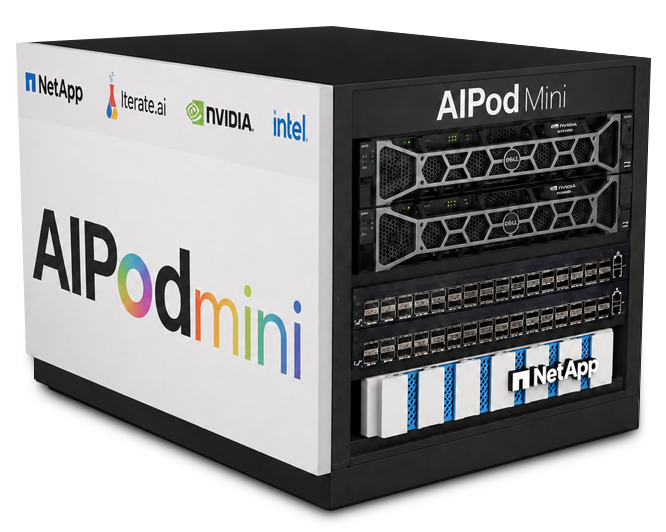
AIPod Mini is built for the first column. NetApp® supplies the governed storage, Iterate.ai supplies the model layer, and both run on hardware the customer owns — so no question has to leave the building to be answered.
Nearly every supplier will use the word private. Very few can put a check in all eleven rows. Ask which column they are in, then check the last four rows yourself.
Read: “The Reverse Information Paradox” by Satya Nadella,
Chairman and CEO, Microsoft — snscratchpad.com (Jul 12, 2026). Why a shared model collects
your know-how even when your files stay put.
Also: “From Static to Dynamic — The Next Frontier of Self-Learning
AI” — Iterate.ai. Why the gap between these columns widens as models keep
learning.
Also: What Private AI Actually Means — the three-part test behind this
table: data, model and hardware.
A joint educational series on private AI and the AIPod Mini. NetApp — the governed data-control layer. Iterate.ai — the private intelligence layer.