

NetApp
Iterate.ai
NetApp Sellers & Partners
Joint Educational Series
Field Brief · How Fragments Become a Map

The Puzzle Effect

AI does not need your whole story. It only needs the pieces — and your people hand them over one at a time.

What you'll learn
  • How harmless-looking fragments assemble into a picture nobody meant to share
  • Why no single person in the chain does anything wrong
  • What that assembled picture is worth to someone who should not have it
The core argument

Nobody in your company would email a competitor the pricing strategy. But over a few months one person asks an AI to tidy a pricing memo, another to summarize a supplier contract, a third to reword a board-deck outline. Each request is small, sensible, and cleared by nobody in particular.

ISOLATED FRAGMENTSA PROMPT GOES LOOKINGINFERENCE FILLS THE GAPSA process, described once.A timeline, mentioned once.A priority, named in passing.A limit, explained for help.Individually, each one is harmless.One word, several meanings.“bank” — river? vault? piggy??Several pieces could fit.A vector database uses the surroundingwords to rank which are closest.Generate runs it inside the AIPod Mini.Strategy. Weak spots.What you plan next.Nobody handed over the picture.

Nothing assembles until somebody asks. A prompt arrives, a vector database returns the pieces closest to it in meaning, and the model holds those pieces together while it answers — filling in what was never written down. That last step is the inference. Meaning depends on company: “bank” is a river, a vault or the piggy kind depending on the words around it, and that is what the database compares. Iterate’s Generate runs the whole sequence inside the AIPod Mini, where the prompts stay private.

How the picture assembles itself

Nobody leaked anything. Everyone contributed a piece. The picture assembled itself.

NetApp | Iterate.ai
The Puzzle Effect · 01 / 02

What the picture costs when it sits somewhere else

IBM’s 2026 Cost of a Data Breach Report is the edition where the AI numbers stopped being a side note.

43%
of security incidents involved staff using unapproved AI tools — more than double the year before
$6.0M
average cost of an AI-enabled breach — about $1M above the $4.99M all-breach average
92%
of organizations breached through an AI system had no proper AI access controls

IBM Cost of a Data Breach Report 2026 with the Ponemon Institute — 602 organizations, Jul 29, 2026.

The gap is governance, not technology. Close to seven in ten breached organizations had no policy for managing AI or spotting unapproved use. An AI system also widens the blast radius. A stolen file is one file. A system that has already assembled the picture is a single door onto all of it — and it answers questions in plain language.
What actually helps
  • Give people a sanctioned AI good enough that they stop reaching for an unapproved one. Shadow AI is a symptom of a tool gap.
  • See the gap. Iterate’s AgentWatch monitors AI use across teams, apps and agents — the visibility most breached organizations did not have.
  • Put the model where your existing access controls already apply, so the picture inherits the permissions your data already has.
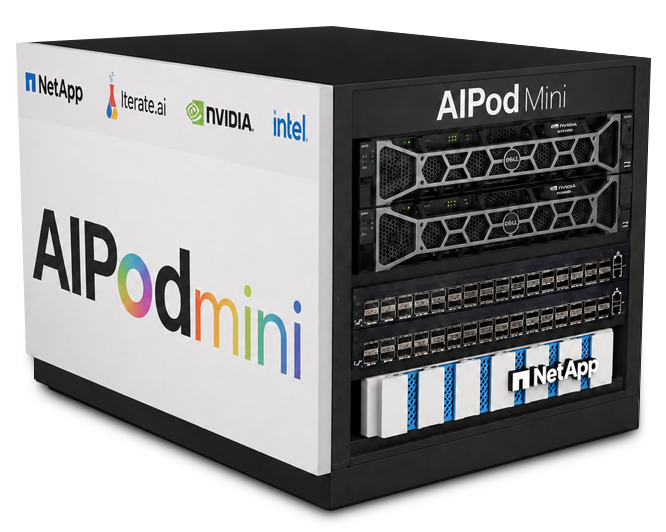
AIPod Mini keeps the puzzle, and the assembling, inside your walls

The AIPod Mini runs the model on NetApp® storage you own. The fragments never leave your infrastructure and existing access controls carry through. Agents built on it work from that same picture, under those same controls — so autonomy does not mean the picture travels.

The only decision left

You cannot un-assemble the picture. You can decide who else gets to look at it.

Further reading

On how a model draws a conclusion nobody asked for: I Hadn’t Mentioned My Dogs. On what it keeps afterwards: The Oohs, Awes, and Dangers of AI Memory.

About this series

A joint educational series on private AI and the AIPod Mini. NetApp — the governed data-control layer. Iterate.ai — the private intelligence layer.
AIPod Mini
NetApp
Iterate.ai
v1.1 · Aug 11, 2026
NetApp | Iterate.ai
The Puzzle Effect · 02 / 02