
NetApp
/
What’s in Private AI Certified — Premium
/
Where Regulation Makes Private AI the Safer Bet
NetApp
Iterate.ai
NetApp Sellers & Partners
Joint Educational Series
Field Brief · Regulated Work

Where Regulation Makes Private AI the Safer Bet

No rule says the hardware must be yours. Many rules make it the shorter road.

What you'll learn
  • Why a regulator’s first question is location, not models
  • What HIPAA, GDPR and federal rules require, and what they leave to you
  • Residency versus ownership — where most pitches get it wrong
The core argument

An auditor rarely asks which model you chose. The question is narrower and harder: where was the data when the answer was made, and who else could reach it?

That is a question about geography, not intelligence, and every boundary the data crosses turns into paperwork. The distinction that matters: no mainstream regulation requires AI to run on hardware you own. The rules mandate outcomes, and sometimes geography. Private deployment is not compliance — it removes several routes by which compliance gets complicated.

THE ANSWER IS MADE OUTSIDETHE ANSWER IS MADE INSIDEYour buildingboundaryShared model• Transfer mechanism• Processor agreement• Residency attestation• Retention termsEach crossing is a filing.Your buildingPrivate modelno boundary• No transfer to document• No outside processor• One location, always• Delete means deletedNothing to file.
Four things that stop being your problem
  • Transfer mechanisms. No crossing, no lawful-transfer route to defend.
  • Sub-processor sprawl. Every outside service is another agreement to audit and renew.
  • Residency attestations. “Where is it right now?” has one answer.
  • Deletion you can prove. You cannot delete what a shared model already learned.
An earlier problem, not a harder one

Regulated industries do not have a harder AI problem. They have an earlier one.

NetApp | Iterate.ai
Where Regulation Makes Private AI the Safer Bet · 01 / 02

Three regimes, one shared question

Different rules, different acronyms, and underneath them the same concern: what left, where did it go, and can you prove it.

HIPAA — health

Cloud processing of PHI is permitted, with a business associate agreement. Each one is a counterparty to negotiate, audit and renew. Keeping PHI inside the covered entity removes the counterparty instead of managing it.

GDPR — personal data

Personal data leaving its region needs a lawful route — adequacy, standard contractual clauses — documented and re-defended whenever those mechanisms are challenged. If record and model share a building, there is no transfer to justify.

Federal and defense

Controlled unclassified information can run in authorized cloud — FedRAMP exists to permit exactly that. Above it, in classified and compartmented work, the practical answer narrows to infrastructure the government itself controls.

The audit question, and how to be ready for it
  • What did the AI read? Every retrieval should be attributable to a source record, not summarized from somewhere unnamed.
  • Who was asking? If a person cannot open a file, the agent acting for them should not be able to either — and the log should show that.
  • Can the record of that be altered? SnapLock write-once retention on NetApp® ONTAP makes the access trail immutable, which is the part an auditor tests.
Residency is not ownership. Residency rules say which country the data must sit in — a data center in the right place satisfies them, and it does not have to be yours. No mainstream rule says the hardware must be yours. Running privately removes several questions rather than answering all of them; compliance still rests on the policies, contracts and controls around the technology. Educational only, not legal advice — confirm specifics with your own counsel.
The question an auditor would ask

Ask a regulated prospect one question: if an auditor asked what your AI read last Tuesday, could you show them? The answer is an architecture decision.

Further reading

On containment when an agent misbehaves: You Already Own the Walls. On what a vendor contract does and does not cover: “Your Data Doesn’t Train Our Model.” Technically. On sorting workloads by sensitivity: Where Should Your AI Actually Run?

Full series — iterate.ai/partners/netapp/papers.

About this series

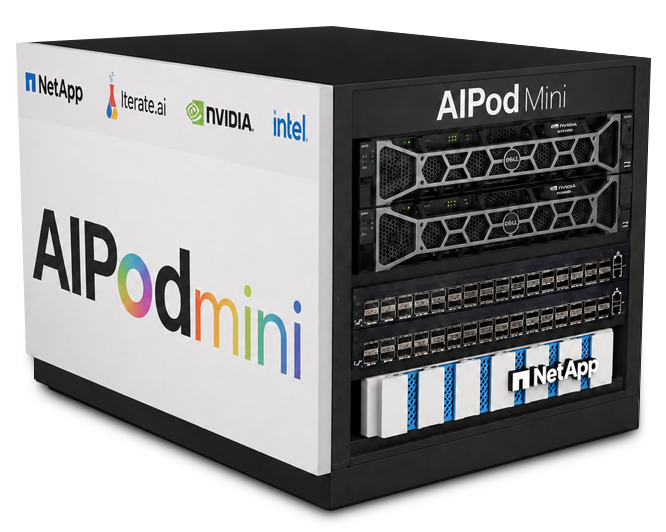
A joint educational series on private AI and the AIPod Mini. NetApp — the governed data-control layer. Iterate.ai — the private intelligence layer.
AIPod Mini
NetApp
Iterate.ai
v1.2 · Aug 11, 2026
NetApp | Iterate.ai
Where Regulation Makes Private AI the Safer Bet · 02 / 02