
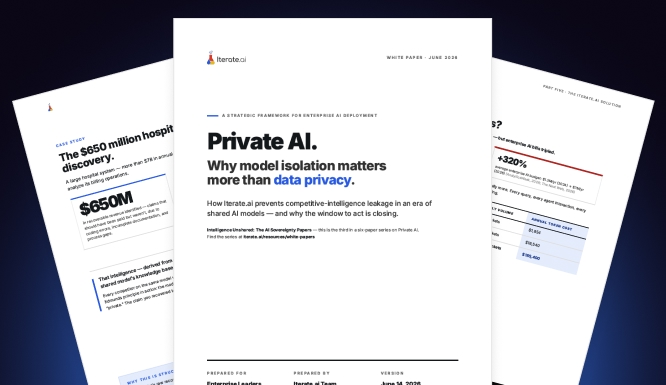
The core intellectual argument: data privacy ≠ model privacy.
Most AI privacy discussions focus on whether a vendor can see your files. But that misses the deeper, more profound issue: shared AI models (ChatGPT, Claude, DeepSeek) absorb intelligence from every interaction and make it available to everyone else. The old IT systems didn't work that way.
This paper explains how shared models accumulate intelligence from every user interaction, why contractual promises can't prevent model learning (including nested learning, reverse engineering, and recursive self-improvement), and introduces the three pillars of true private AI: data, model, and hardware privacy.
In simple terms, the problem isn't only whether the AI can read your information — it's whether it learns from it in ways that benefit everyone else, including your competitors.
—
A six-paper series on Private AI
Intelligence Unshared: The AI Sovereignty Papers
1 of 6: When Software Started Thinking2 of 6: The Token Tax3 of 6: Private AI — Why Model Isolation Matters More Than Data Privacy
4 of 6: Owning Intelligence5 of 6: The Death of the Token Tax6 of 6: From Static to Dynamic — The Next Frontier of Self-Learning AI