
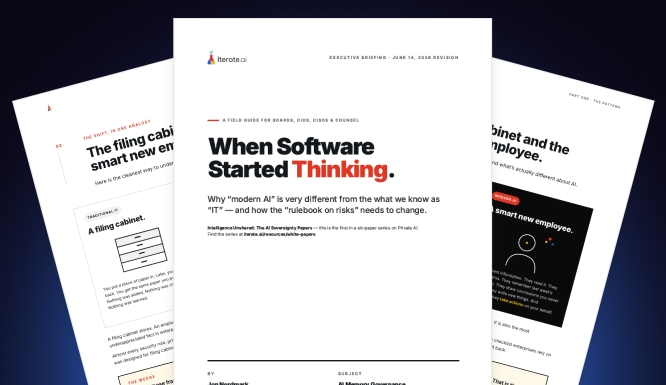
New research from Iterate.ai reveals why modern AI is fundamentally different from traditional IT—and why enterprise leaders need a new risk rulebook for systems that read, remember, reason, and act. For fifteen years, boards, CIOs, CISOs, and legal teams governed cloud risk by asking where data was stored and who could access it. But AI introduces a deeper question: who is accumulating intelligence from your data, workflows, employees, customers, and behavior over time? What the research reveals:
- Why traditional IT frameworks no longer fit modern AI. Legacy systems act like filing cabinets: they store information and return it later. AI behaves more like a smart employee: it reads, remembers, connects patterns, draws conclusions, and increasingly takes action on your behalf.
- How AI memory creates a new governance challenge. Enterprise information can persist across session windows, persistent memory, embeddings, vector databases, retrieval indexes, fine-tuning corpora, agent state, and model weights. Most organizations cannot yet map, audit, or delete all the places their AI memory lives.
- Why shared AI changes the platform-risk equation. Companies once thought they were outsourcing infrastructure to platforms like Amazon. In reality, they were outsourcing learning. Today, enterprises may be making the same mistake by connecting contracts, source code, customer data, financial records, and institutional knowledge into shared AI systems.
- Why agents expand the blast radius of AI risk. AI systems are no longer limited to answering questions. Agents can send emails, write code, file tickets, place orders, and trigger workflows. When one agent makes a bad inference—or passes it to another agent—the error can become a real-world action at machine speed.
Download the full whitepaper. Fill out the form to download, and discover the hard questions enterprise leaders must ask about AI memory, shared models, inference location, vendor control, agent authority, vector databases, and Private AI before today’s tactical AI decisions become tomorrow’s structural dependencies. Modern AI does not just store information. It accumulates understanding. And once software starts thinking, the old IT risk rulebook starts breaking down.
The question is no longer simply where your data sits. It is where your intelligence lives, where it evolves, and who controls it. Modern AI is not modern IT. The risk framework has to change. Iterate.ai AI Memory Governance Research, May 2026